
Few gardening experiences are more disappointing than watching a tray of promising seedlings struggle.
One week they appear healthy and full of potential. The next, they are collapsing, turning yellow, stretching towards the light or simply failing to grow.
Most gardeners have experienced it.
In fact, if you’ve ever lost a batch of seedlings, you’re in very good company.
The encouraging news is that seedling failure is rarely caused by bad luck. More often than not, there is a clear reason why young plants struggle, and once you understand the cause, success becomes far more predictable.
After years of speaking with gardeners, allotment holders and home growers, the same issues appear time and time again.
Understanding these problems can dramatically improve your success rate and help you raise stronger, healthier plants throughout the growing season.
The First Thing to Remember: Seedlings Are Not Mature Plants
One of the most common mistakes gardeners make is treating seedlings like fully established plants.
A seedling has a tiny root system, limited energy reserves and very little capacity to recover from stress.
Small mistakes that an established tomato, chilli or courgette plant could easily tolerate may prove fatal to a seedling.
During the first few weeks of life, consistency is everything.
Starting Seeds Successfully: Why the First Few Weeks Matter
Many gardeners focus on what happens after a seed germinates, but the earliest stage of growth is often the most critical.
A seed only gets one opportunity to establish healthy roots.
If the growing environment is too wet, too dry, poorly aerated or inconsistent, problems often appear long before the first true leaves develop.
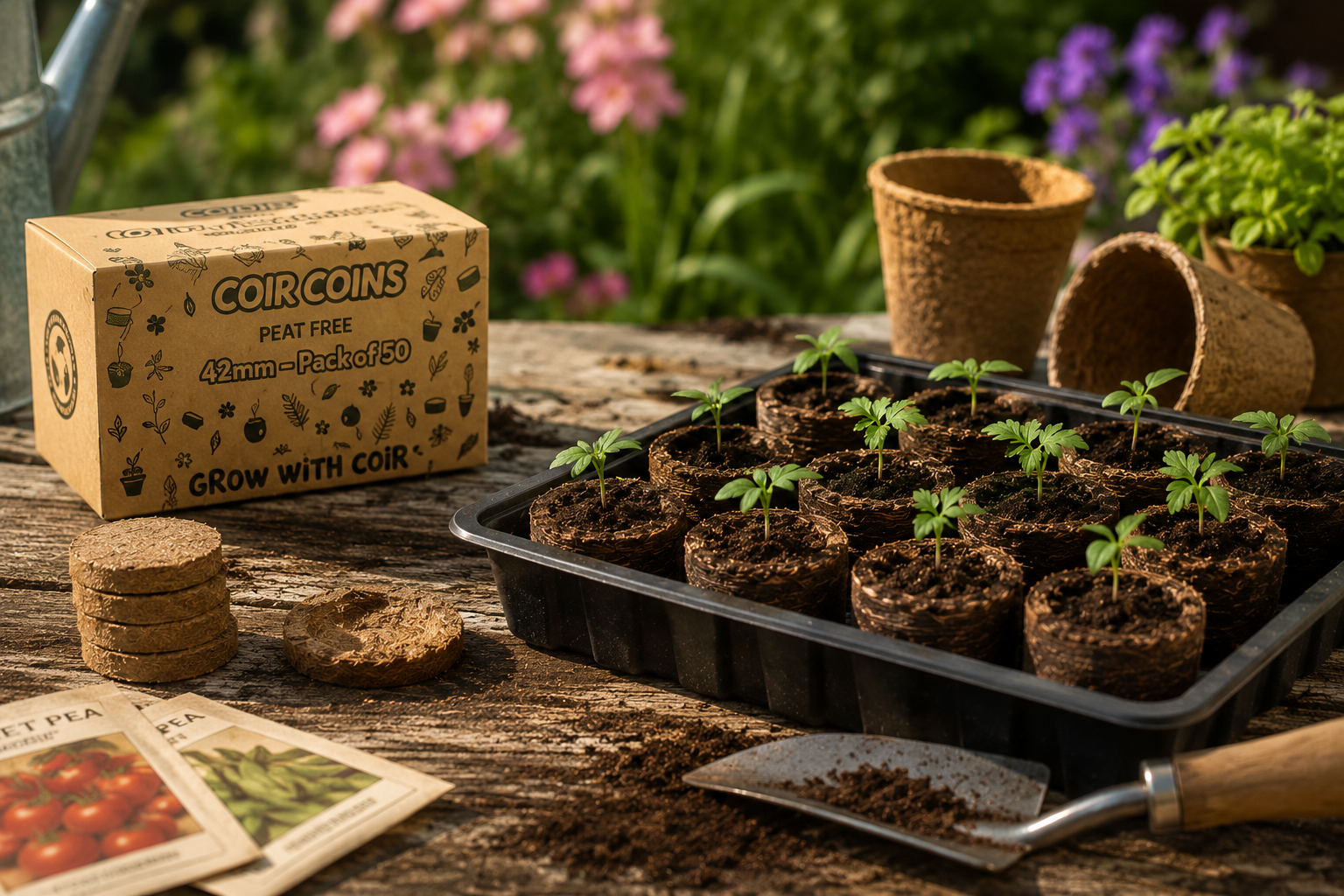
This is one reason coir coins have become increasingly popular amongst gardeners. Once hydrated, a coir coin expands into a compact growing plug that provides a simple and consistent environment for germination.
Many gardeners use them for:
- Tomatoes
- Chillies
- Peppers
- Cucumbers
- Courgettes
- Herbs
- Sweet peas
- Sunflowers
Because each seed develops within its own growing plug, roots experience less disturbance during transplanting, helping young plants establish more quickly once moved into larger containers.
For beginners, coir coins can also remove much of the guesswork from seed sowing by providing a ready to use growing medium with good moisture retention and airflow around developing roots.
The result is often stronger germination and healthier early growth.
Overwatering: The Silent Killer
If there is one issue responsible for more seedling losses than any other, it is overwatering.
Many gardeners assume that because seedlings are small, they require constant moisture.
In reality, seedlings need a balance between water and air.
Healthy roots require oxygen.
When growing media remain saturated for prolonged periods, oxygen levels fall and roots begin to suffer.
Typical symptoms include:
- Yellowing leaves
- Slow growth
- Wilting despite damp compost
- Stem collapse
- Root rot
The aim is not to keep the compost wet.
The aim is to keep it evenly moist.
There is an important difference.
Insufficient Light
Every spring, countless seedlings begin their lives on windowsills throughout Britain.
Unfortunately, many of those windowsills do not provide enough light.
When seedlings fail to receive adequate light, they begin stretching towards the nearest source.
This is known as becoming “leggy”.
Leggy seedlings often have:
- Thin stems
- Weak growth
- Pale foliage
- Poor stability
Once a seedling becomes severely elongated, it rarely develops into a strong plant.
Whenever possible, seedlings should be grown in the brightest position available.
Sowing Too Early
This surprises many gardeners.
Enthusiasm often gets the better of us.
A warm day arrives in February and suddenly seed packets are coming out of drawers across the country.
However, sowing too early can create problems.
Seedlings that germinate months before they can be planted outside often become:
- Root bound
- Weak
- Stressed
- Difficult to manage
A healthy seedling raised at the correct time frequently overtakes an older seedling that has spent weeks struggling in a small pot.
Poor Root Development
Gardeners naturally focus on what they can see above the surface.
Yet seedling success begins underground.
Strong roots support:
- Water uptake
- Nutrient absorption
- Healthy foliage growth
- Disease resistance
- Future crop production
Many seedling problems can be traced back to poor root development during the earliest stages of growth.
This is why the choice of growing medium matters.
A good propagation medium should provide:
- Moisture retention
- Airflow around roots
- Structural stability
- Consistent growing conditions
Young roots are surprisingly sensitive, and the environment around them often determines whether a seedling thrives or struggles.
Potting On: A Stage Where Many Seedlings Struggle
A surprisingly common cause of seedling failure occurs after germination.
The seedling may have emerged perfectly well, only to stall after being moved into a larger container.
This often happens because roots become disturbed during transplanting.
Many gardeners use coir pots to help minimise this problem.
Unlike traditional plastic pots, coir pots can be planted directly into containers, raised beds or garden borders. This reduces handling and allows roots to continue growing with less interruption.
Particularly for crops such as tomatoes, chillies, cucumbers and courgettes, reducing transplant shock can make a noticeable difference to early establishment.
Choosing the Right Potting Mix
Once seedlings have outgrown their propagation trays, they require a growing medium capable of supporting stronger root development and sustained growth.
Many gardeners make the mistake of leaving seedlings in propagation compost for too long.
At this stage, a quality potting mix becomes important.
Coir-based potting mixes such as Coir Vital Grow® are often used to provide a balance of moisture retention, drainage and aeration, helping young plants continue developing healthy root systems as they mature.
The healthiest seedlings are usually those that transition smoothly from germination into active growth without major interruptions or stress.
Temperature Matters More Than Many Gardeners Realise
Seeds are remarkably sensitive to temperature.
Even when moisture and light levels are correct, poor temperatures can slow germination or weaken growth.
Many popular vegetables perform best when germinated in stable, moderately warm conditions.
Sudden temperature fluctuations can create stress and lead to uneven development across seed trays.
Consistency is usually more important than excessive heat.
Overcrowding
It is tempting to sow generously.
After all, every gardener wants a good display of seedlings.
However, overcrowding quickly creates competition.
Seedlings begin fighting for:
- Light
- Water
- Nutrients
- Air circulation
The result is often weaker plants and increased susceptibility to disease.
Thinning out seedlings may feel ruthless, but it frequently improves the overall quality of the plants that remain.
Damping Off Disease
Many gardeners encounter damping off without realising what it is.
One day a seedling appears healthy.
The next, the stem has collapsed at soil level.
Damping off is caused by fungal pathogens that thrive in overly damp, poorly ventilated conditions.
Good hygiene, sensible watering and adequate airflow are often the most effective preventative measures.
Feeding Too Soon
This is another common mistake.
Seedlings do not require large amounts of fertiliser immediately after germination.
In fact, excessive feeding can damage delicate roots.
Young plants should be allowed to establish themselves before more intensive feeding programmes begin.
Patience usually produces better results than rushing.
Why Some Gardeners Seem to Have Better Success
It is easy to assume that experienced gardeners possess some special secret.
In reality, successful growers usually do a few simple things consistently:
- They avoid overwatering.
- They provide sufficient light.
- They monitor temperatures.
- They avoid overcrowding.
- They prioritise root health.
- They transplant carefully.
There is no magic involved.
Just good habits repeated over time.
Final Thoughts
Every healthy tomato plant, chilli plant, sunflower and sweet pea began life as a fragile seedling.
The difference between success and failure is rarely luck.
Most seedling losses can be traced back to a handful of common issues that are entirely preventable once recognised.
Focus on creating the right conditions rather than constantly intervening.
Provide young roots with moisture, oxygen, warmth and stability.
Allow seedlings to develop at their own pace.
And remember that successful gardening is not about perfection. Even the most experienced growers lose seedlings from time to time.
The goal is not to avoid every mistake.
The goal is simply to learn from them and become a better gardener with every season that passes.
 Share:

Leave a Reply