
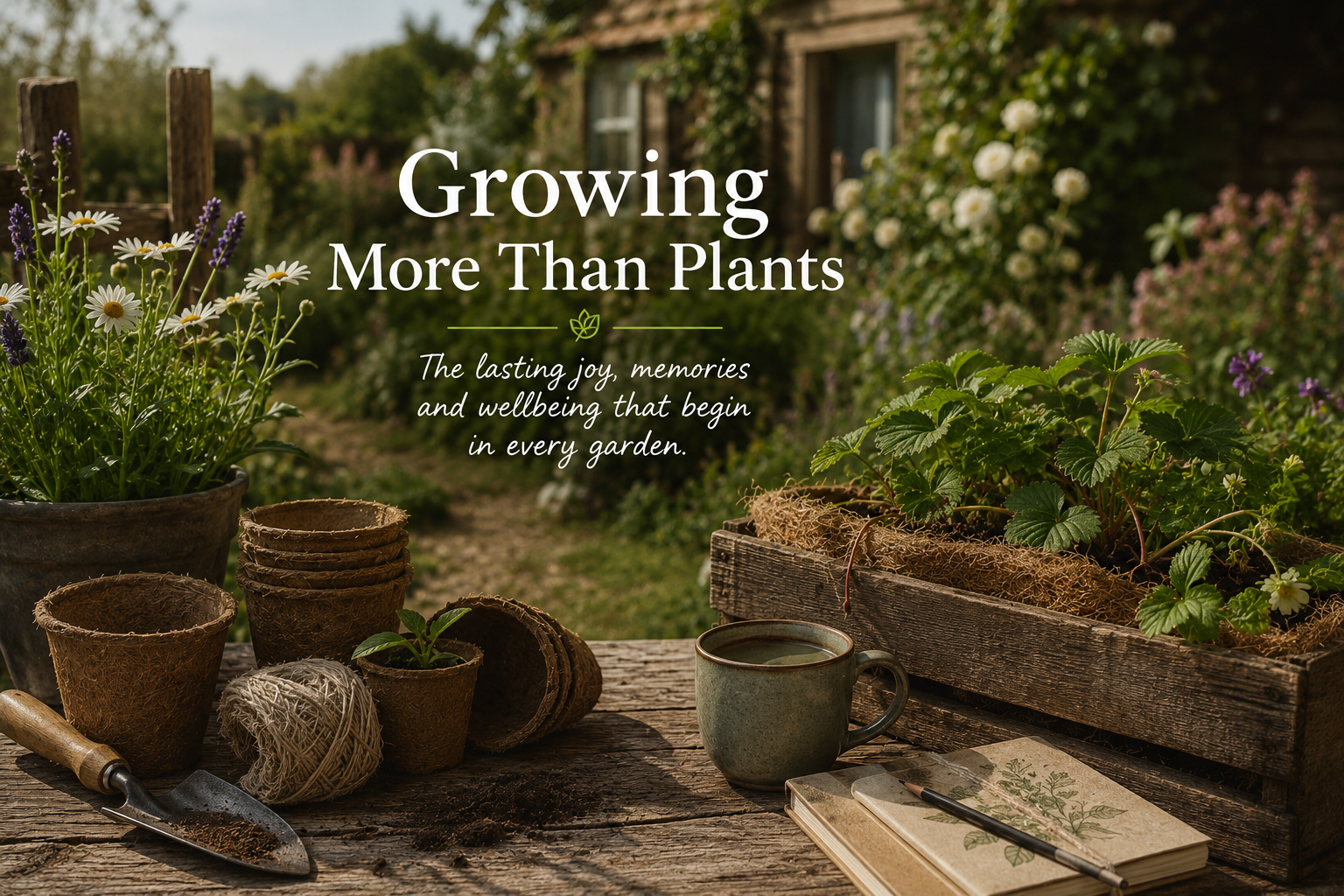
Why Growing Something Changes More Than Your Garden
A Garden Begins Long Before the First Seed
There is a particular moment that arrives almost unnoticed on a summer morning. The kettle has only just boiled, the grass is still carrying the night’s dew and somewhere beyond the hedge a blackbird is already convinced the day belongs to him. Before the first email has been answered or the telephone begins its familiar chorus, the garden has quietly gone about its business without asking anything of us at all. Standing outside for only a few minutes and it becomes surprisingly difficult to remember what seemed so urgent half an hour earlier. A climbing rose has opened overnight, the lavender hums gently with bees that arrived before breakfast, somewhere beneath broad green leaves, the first strawberry of the season has ripened unnoticed. Nothing remarkable has happened, yet somehow everything feels different. Perhaps that is the quiet gift every garden offers. It asks us, if only for a little while, to exchange hurry for attention.
We often speak about gardens as though they exist to produce flowers, vegetables or neatly trimmed lawns. Beautiful though those things undoubtedly are, they have never been the real reason people fall in love with gardening. Think back to the gardens you remember from childhood, few of us recall the exact variety of rose growing beside the gate or whether the tomatoes were a heritage cultivar or an ordinary supermarket packet of seeds. What we remember instead are moments, the smell of freshly cut grass drifting through an open kitchen window, the excitement of discovering a ladybird resting on a bean cane, picking raspberries that somehow never made it into the bowl because they were eaten before reaching the house. A grandfather patiently explaining why broad beans should never be harvested too late, or a grandmother returning indoors with an armful of sweet peas that filled every room with fragrance for days afterwards. The garden quietly became the setting for memories that had very little to do with plants.
Perhaps that is why gardening has never really disappeared, despite the extraordinary pace of modern life. Our homes have become filled with devices designed to save time, yet many of us feel busier than ever before. We move from one appointment to the next, glance at our telephones more often than we care to admit and find ourselves measuring the day by lists rather than experiences.
Gardens operate according to entirely different rules. The first daffodils arrive when winter has finally loosened its grip, runner beans climb patiently towards the summer sun without any concern for deadlines, apples ripen because the season is ready, not because our calendars demand it. Nature has never hurried, and perhaps that is precisely why spending time amongst growing things feels so restorative. The garden reminds us that not everything worthwhile can be rushed.
One of the greatest misunderstandings about gardening is the belief that it belongs to people blessed with sweeping lawns, immaculate borders or beautifully restored Victorian greenhouses. The truth is considerably kinder than that. Some of the happiest gardens occupy little more than a balcony overlooking a busy street, others begin with a terracotta pot standing quietly beside a back door. Many lifelong gardeners started with nothing more ambitious than a packet of basil seeds balanced on a sunny kitchen windowsill. Gardening has never been about the amount of space available, it has always been about the willingness to begin. There is also a curious freedom in being a beginner. Experienced gardeners will readily admit that they still make mistakes such as plants occasionally failing, unexpected frosts arriving without invitation and slugs possessing an uncanny ability to discover the one specimen we were most hoping to protect. Yet none of these disappointments discourage those who genuinely enjoy gardening, if anything, they become part of the story. Every gardener remembers the sunflower that grew twice as tall as expected, equally, every gardener remembers the tomatoes that stubbornly refused to ripen one particularly disappointing summer. Neither experience is wasted, one teaches delight, the other teaches patience. Perhaps this is why gardens become so deeply personal.
Unlike many pursuits, gardening offers no final examination and no perfect result. Every season begins with optimism and ends with fresh experience. There is always another variety worth trying, another corner waiting to be transformed or another lesson quietly waiting beneath the soil. The garden never asks us to become experts, it simply rewards those who continue to return.
The Garden Doesn’t Measure Success
There is an old saying amongst gardeners, which is that no two seasons are ever the same.
It sounds wonderfully obvious until you’ve lived through enough springs to understand quite how true it is. One year the tulips seem to appear almost overnight, painting borders with impossible shades of crimson and gold. Another year they linger beneath the soil, waiting patiently for warmth that refuses to arrive. Tomatoes that flourished magnificently one summer may sulk the next, while a rose that barely managed a handful of flowers suddenly becomes the pride of the garden. Nature has never promised consistency, perhaps that is one of the reasons it continues to fascinate us.
Unlike almost every other part of modern life, gardening cannot be hurried, automated or guaranteed. It asks us to work with the seasons rather than against them, accepting that success is often measured not by perfection but by quiet progress.
Children understand this instinctively. Give a young child a packet of sunflower seeds and they rarely ask whether they are easy to grow, how tall the variety will become or whether they have won awards at Chelsea, they simply want to know what happens next. Every morning becomes a small expedition to see whether anything has changed. Has the seed appeared? Has it grown taller? Will it flower before the summer holidays? The smallest signs of progress become moments of genuine excitement. Somewhere along the way, without anyone announcing it, they begin learning lessons that have very little to do with gardening itself but are skills they take through with them in life. These skills are important for their growth and development and what they learn from such a simple hobby are skills such as patience, responsibility, observation, and so many more core skills that help them navigate through life. Long before children understand words such as sustainability or biodiversity, they understand something far simpler, if you nurture something consistently, it has every chance of flourishing. It is a lesson that reaches far beyond the garden gate.
Another moment a garden provides for us are the memories we share as families within them. Ask almost anyone about the gardens they remember most vividly and they are unlikely to begin describing flower borders. Instead, they speak about people, grandad showing them how to earth up potatoes, mum calling everyone inside because supper was ready while one last strawberry still needed picking. The excitement of carrying muddy carrots into the kitchen as though they were treasure. The annual ritual of choosing a pumpkin that somehow always seemed larger than last year’s. Gardens quietly collect family history with moments like birthdays celebrated beneath apple trees, Sunday lunches eaten outdoors whenever the British weather showed even the slightest encouragement, children measuring themselves against towering sunflowers, dogs chasing tennis balls across lawns that were never quite as tidy afterwards. Years later, those moments become impossible to separate from the places in which they happened. A garden is never simply somewhere we grow plants, it is often where families grow together.
Small Gardens, big beginnings, there remains a curious belief that gardening requires space. Perhaps it is because magazines so often celebrate sweeping country estates or immaculate formal gardens. They are undoubtedly beautiful, they are also wonderfully unrealistic for most people. The truth is that Britain’s gardening tradition has always been built upon modest spaces. Such as terraced gardens bursting with climbing roses, window boxes overflowing with trailing geraniums, tiny front gardens transformed by lavender and hydrangeas. Balconies alive with herbs, tomatoes and strawberries, even a single pot beside the front door has the power to change the way a home feels. Gardening has never depended upon acreage, it depends upon attention. A single healthy plant cared for well brings considerably more satisfaction than a garden full of neglected ambition.
One of gardening’s most generous qualities is that confidence rarely arrives all at once. It appears gradually, often without us noticing. The basil plant that survived the winter encourages us to grow parsley next year, the tomato harvest gives us the confidence to try cucumbers, the hanging basket that flowered beautifully throughout the summer persuades us that perhaps next year we might tackle the border beneath the fence. Each small success makes the next challenge feel a little less intimidating. Experienced gardeners are rarely fearless, they are simply people who have discovered that failure is not the opposite of success. It is part of the process, every gardener has lost plants, every gardener has made mistakes, every gardener has looked at an empty pot and wondered why nothing appeared. Yet remarkably few would describe those experiences as failures. Instead, they simply become next year’s knowledge.
Gardening is more than just a hobby which may explain why gardening remains one of Britain’s most enduring pastimes, it is never truly finished. There is always another variety to try, another corner waiting for inspiration, another season bringing its own surprises. The pleasure lies not in reaching the end but in continuing the journey. Slowly, almost without noticing, the garden changes. And so do we.
The harvest we never expected
There is an old joke amongst gardeners that the most expensive tomato you will ever grow is your first. By the time you’ve bought the seeds, found a sunny corner, invested in a watering can and proudly admired the plant for several months, that single tomato could probably have been purchased many times over from the local greengrocer. And yet no gardener would ever swap the experience because the first tomato you grow yourself has very little to do with its value at the dinner table. It represents something entirely different. It is proof that, with a little patience and a little care, something remarkable can begin with almost nothing at all. The first fruits are seldom perfect, they may be slightly uneven, unexpectedly small or determined to ripen just as the weather turns. None of that matters. What matters is that you remember exactly how they came to be, you remember sowing the seed on a cold spring afternoon when summer still felt impossibly distant, you remember wondering whether anything would happen, you remember the excitement of the first tiny leaves unfolding towards the light, or you remember moving the young plant into a larger pot because, almost overnight, it had outgrown the one before. And finally, after weeks of waiting, there it is. One tomato which is still warm from the afternoon sunshine. Most gardeners never carry that first tomato into the kitchen instead they eat it exactly where they picked it. It may not be the sweetest tomato they will ever taste but it is almost always the one they remember.
There is a curious shift that happens when we grow even a small amount of our own food. Fresh herbs are no longer an afterthought purchased on the way home from work. They become something you snip moments before supper, still carrying the fragrance of the morning sunshine.A handful of salad leaves suddenly feels rather precious because you watched every one of them emerge from the soil. The strawberries disappear long before they reach the fruit bowl, usually because someone insists on “just trying one” before walking back into the house. Even children who would normally show little enthusiasm for vegetables often become remarkably interested in eating something they have grown themselves.Perhaps it is because the harvest belongs to them, or perhaps food simply tastes different when it carries a story. Growing our own produce does something rather unexpected, it reminds us where food begins. Not on supermarket shelves, not inside refrigerated cabinets, but in healthy soil, careful hands and changing seasons. It encourages gratitude in a way that convenience rarely can.
One of the loveliest traditions in British gardening has nothing to do with winning prizes or producing the largest vegetables. It is sharing. Almost every gardener has, at some point, stood on a neighbour’s doorstep holding a bag of runner beans because there were simply too many to eat. Courgettes have an extraordinary habit of appearing in unexpected places during August, a handful of fresh mint finds its way into somebody else’s kitchen, a vase of sweet peas brightens a dining table across the road. Nobody keeps score, nobody expects anything in return. Gardens have always encouraged generosity because abundance has a way of multiplying when it is shared. These are quiet acts, small gestures, yet they strengthen communities far more than we often realise. A conversation begins over a garden fence, advice is exchanged about tomatoes. Someone asks how to grow lavender, another recommends a favourite variety of climbing rose. Before long, strangers become neighbours, and neighbours become friends. Perhaps this is one of gardening’s greatest achievements. It grows relationships every bit as successfully as it grows flowers.
Many of us now measure the passing of the year by diaries, school holidays and bank holidays. Gardeners notice different milestones. Like the first snowdrops emerging while winter still feels firmly in charge, the arrival of swallows, apple blossom drifting through the orchard, the scent of freshly mown grass on an evening that finally feels like summer, and the first frost quietly silvering the lawn. Gardening has a wonderful way of reconnecting us with the rhythm of the seasons. Instead of wishing time away, we begin to anticipate it, every month brings something different. Every season has its own character. There is comfort in that gentle cycle, it reminds us that change is not something to fear. It is simply part of growing. The garden teaches us more than we expect. Ask an experienced gardener what they have learned over the years and they will probably begin by talking about plants. Listen for a little longer, however, and something rather different begins to emerge. They speak about patience, about persistence, about accepting that not every year will be perfect, about learning to appreciate small victories, about the satisfaction of watching something thrive because they cared enough to keep turning up. Perhaps those are the lessons we were searching for all along. The flowers simply gave us a beautiful excuse to discover them.
Looking after tomorrow
There comes a point in almost every gardener’s life when the question quietly changes. At first, we simply ask ourselves whether a plant will grow. Later, we begin asking something rather different.Will this garden still flourish next year? Will there be more bees than there were last summer? Will the apple tree provide enough blossom for another generation to enjoy? The questions become less about individual plants and more about the garden as a living place. Perhaps that is one of the most remarkable things gardening teaches us, it gently encourages us to think beyond ourselves.
Every garden we grow, see, or walk past is borrowed, walk through the grounds of an old country house or a National Trust garden and one thought returns again and again. Very few of the people who planted those magnificent trees ever lived to see them fully grown. Someone, perhaps a century ago, stood exactly where we stand today, carefully placing a young sapling into the ground with little certainty of what the future might hold. They planted not for themselves alone, but for people they would never meet. There is something deeply moving about that, gardening has always been one of the quietest acts of optimism. Each bulb planted in autumn carries the simple belief that spring will return, each fruit tree represents faith in seasons yet to come, each handful of seeds is, in its own modest way, a vote of confidence in tomorrow.
Another factor is the answers we each have to a question are always different when it comes to our individual opinion. For example if you were to ask ten experienced gardeners the secret to a healthy garden and you are likely to receive ten different answers. Some will talk about sunshine, others will speak passionately about watering, many will champion careful pruning. However, sooner or later almost every conversation arrives at exactly the same place. The soil. Long before the first flower appears or the first tomato ripens, everything begins beneath the surface, healthy roots, healthy soil, and healthy growth. It is easy to overlook because it remains largely invisible. The finest gardens rarely draw attention to what lies underground, yet without strong foundations, very little above ground can truly flourish. Perhaps gardens are rather like people in that respect. The strongest growth often begins where nobody else is looking. Today’s gardeners have access to more information than ever before. Advice arrives through books, gardening programmes, local societies, neighbours, online communities and experienced growers who are often wonderfully generous with their knowledge. Alongside that knowledge comes another opportunity, the opportunity to make thoughtful choices. More people are considering how they collect rainwater, how they encourage wildlife, how they support pollinators, how they reduce unnecessary waste, how they care for the soil that supports every plant they grow. None of these decisions need to be dramatic. In fact, the most meaningful changes are often the smallest ones, repeated consistently over many seasons. A wildlife corner left undisturbed, a compost heap quietly working away behind the shed, native flowers planted for bees. Choosing growing materials that reflect the kind of garden we hope to leave behind. Gardening has never been about perfection, it has always been about care.
Why do we choose a different path? When Coir Products was founded, the ambition was never simply to supply gardening materials. There were already plenty of companies doing that. The ambition was something rather quieter. To help more people discover the confidence to grow, to make gardening feel welcoming rather than intimidating, to encourage beginners as warmly as experienced gardeners, and to champion growing methods that reflected both practical performance and thoughtful stewardship. That philosophy continues to shape every decision we make. Whether someone purchases a single coir pot for herbs on a kitchen windowsill or enough growing media to transform an entire greenhouse, the product itself is only one part of the story. The real purpose is the experience that follows, the first seedlings, the first flowers, the first harvest, the conversations that happen in the garden, the memories that quietly begin taking root, and those are the moments we hope to play a small part in.
There is sometimes a misconception that gardening responsibly requires compromise, that choosing renewable materials somehow means sacrificing enjoyment or success. However, most gardeners discover the opposite, thoughtful choices rarely diminish the pleasure of gardening, they often deepen it. Knowing that the methods we use today contribute, however modestly, to the gardens of tomorrow adds another layer of satisfaction to every season. After all, gardening has never been solely about what we grow. It is also about what we leave behind, every Small Choice Matters. Few of us will transform the world through one afternoon in the garden. Nor do we need to. Gardens have always demonstrated that meaningful change begins with remarkably small actions repeated over time. One seed, one tree, one flower, or one child discovering the excitement of growing something for the first time. Years later, those small beginnings often become the things that mattered most.
If you ask experienced gardeners what they have grown over the years, most will begin with the obvious answers, tomatoes, runner beans, sweet peas, or perhaps a rose that has flourished against a south-facing wall for longer than anyone can quite remember. Leave the conversation for another few minutes, however, and something rather different begins to emerge. They start talking about people, about the neighbour who still pops round every September because “your Bramleys always make the best pies,” about the grandson who insists on watering everything, including the patio, or about the Labrador that somehow knows precisely when strawberries are ready.
Gardens have a habit of collecting stories in much the same way that old houses collect photographs. The longer they are cared for, the more memories they seem to hold. My own favourite gardens have never been the grandest ones. In truth, some of the most memorable have been the untidy sort. The sort where herbs spill across narrow paths because nobody had the heart to cut them back, where an old wooden bench has weathered to a silvery grey after years of rain and sunshine, where there is usually a robin somewhere nearby, waiting with surprising confidence for the next forkful of earth to reveal breakfast. Those gardens feel lived in, they have character. You can almost tell what sort of people belong there before anyone answers the front door. Perhaps that is because gardens quietly become reflections of those who care for them. Not perfect but simply authentic. Walk through almost any British village on a warm June evening and you’ll notice something rather lovely. Front gardens become places of conversation, someone pauses to admire the foxgloves, another asks whether the roses are an old variety, a passing dog receives considerably more attention than it probably deserves, and five minutes later nobody has quite remembered where they were originally heading. Gardens possess an extraordinary ability to slow conversations down which may seem a curious thing to celebrate. Yet, in a world that often encourages us to hurry from one place to the next, perhaps slowing down is no bad thing at all. There is also a quiet generosity that seems to exist amongst gardeners, advice is offered freely, seeds appear in envelopes with handwritten notes, someone divides a clump of snowdrops simply because they have more than they need, or a neighbour appears with six surplus tomato plants and leaves before you have the chance to refuse. But nobody sends an invoice, and nobody expects repayment. Somehow everybody understands that gardens have always worked rather better when knowledge travels as freely as the plants themselves. It is one of those traditions that deserves protecting. The same is true of experience. No gardening book can quite replicate the wisdom of someone who has spent decades quietly observing the seasons. The gentleman at the allotment who can predict rain by looking at the swallows, the grandmother who insists sweet peas should always be picked generously because “the more you cut, the more they flower.” Whether every piece of advice is scientifically perfect is almost beside the point. Those conversations are part of Britain’s gardening heritage. Knowledge has always travelled from gardener to gardener long before it ever appeared on websites or television.
That is one of the reasons we created the Coir Products Knowledge Hub. Not because we believed the world needed another collection of product pages, but quite the opposite. We wanted to create a place where someone could arrive knowing almost nothing about gardening and leave feeling quietly confident enough to begin. No jargon, no unnecessary complexity, no assumption that everyone already knows the difference between compost, substrate and soil. Just straightforward guidance written by people who understand that every experienced gardener was once staring at an empty pot wondering whether anything would grow. If our articles persuade someone to sow their very first herbs, help a family grow tomatoes together over the summer or give somebody the confidence to rescue an ageing houseplant, then they have achieved exactly what they were intended to do. Because success should never be measured only by what we sell, it should also be measured by what we help other people discover. Perhaps that is the real purpose of gardening, not to create perfection, not to impress the neighbours, and certainly not to produce magazine-worthy borders every summer. Its greatest achievement is rather quieter than that, and it teaches us that worthwhile things take time, that seasons cannot be rushed, that patience usually receives its reward, and that even the smallest beginning has the potential to become something far greater than we first imagined. A seed rarely changes the world. Yet it has an extraordinary habit of changing the person who chooses to plant it.
Every garden leaves something behind
There is an old apple tree in a village not far from where I grew up. Nobody seems entirely certain who planted it. Some believe it belonged to the original cottage that once stood nearby. Others insist it was planted after the Second World War by a family who have long since moved away. The truth hardly matters now. Each autumn it still produces fruit, children still climb its lower branches, neighbours still gather windfalls for pies and crumbles, the people who first placed that young tree into the ground could never have known whose lives it would eventually touch. Perhaps that is one of the quiet miracles of gardening, we rarely see the full consequence of the things we choose to grow.
Every garden tells a story. Some tell stories through magnificent borders filled with colour from spring until autumn. Whereas others whisper more gently. A weathered wooden bench polished smooth by years of afternoon sunshine, a winding path where little feet once ran ahead of everyone else, an old watering can that has somehow survived three decades longer than anyone expected, the climbing rose that has become part of the house itself. Gardens record our lives without ever asking permission. The seasons pass, children become adults, families grow, and people come and go. Yet somehow the garden quietly remembers. There comes a point when most gardeners realise they are no longer gardening solely for themselves. The lavender planted beside the path becomes food for bees, the bird feeder is refilled because someone notices the robin waiting nearby, a tree is planted knowing someone else will one day sit beneath its shade. These are small acts, almost invisible, yet they speak of something rather hopeful.
Gardening has always encouraged us to think beyond the present moment. Long before the phrase “leaving a legacy” became fashionable, gardeners were quietly doing exactly that. At Coir Products, we believe every gardener deserves the confidence to begin. Not because we imagine every customer will create an award-winning garden, most never will, nor should they. The finest gardens are not those photographed for glossy magazines. They are the ones that become part of everyday family life, the herbs growing outside the kitchen door, the tomatoes ripening in the greenhouse, the hanging basket watered by a child before school, and the strawberries picked before breakfast because they simply couldn’t wait another hour. Those moments matter far more than perfect borders. If, in some small way, the products we provide help create those memories, then we have achieved something far more meaningful than making a sale. That is why our Knowledge Hub exists. Not to demonstrate expertise, but to share it. We hope it becomes the sort of place people return to throughout the seasons. A place where first-time gardeners discover confidence, where experienced growers occasionally find a new idea worth trying, and where families find inspiration for spending more time together outdoors. Because gardening has never belonged to experts alone, it belongs to anyone willing to plant something and see what happens. Perhaps that is the greatest lesson a garden offers. It reminds us that the future is rarely created through grand gestures. More often it grows from ordinary decisions made with care, planting a seed, sharing a cutting, teaching a child how to water tomatoes, leaving a few flowers for the bees, or stopping, if only for ten quiet minutes, to notice that another season has arrived. None of these moments appears particularly important while they are happening. Yet together they become the life we remember. Years from now, you probably won’t remember the compost you used. You may not remember the variety of tomato growing in the greenhouse or precisely when you sowed your first seeds of spring. There is every chance, however, that you will remember your daughter proudly carrying her first sunflower into the house. You will remember strawberries eaten before they reached the kitchen. You will remember muddy boots abandoned by the back door after an afternoon spent digging. You will remember the scent of sweet peas drifting through an open window on a warm July evening. You will remember conversations that began over a garden fence and somehow lasted until the sun disappeared behind the rooftops. Because gardens have never really been about plants, they have always been about people, the flowers bloom, the harvest is gathered, the leaves fall, and the seasons continue. Yet the memories keep growing.
Perhaps that is why every truly beautiful garden begins in exactly the same place, with hope, with curiosity. With the simple decision to plant something and care enough to watch it grow. And perhaps that is all gardening has ever asked of us.
From the earth, back to the earth.
 Share:


Leave a Reply