
Ask ten gardeners about watering and you may well get ten different answers.
Some water to a timetable. Some lift the pot to judge its weight. Others simply put a finger into the growing medium and see how it feels.
The truth is that there isn’t one perfect watering routine. The plant, the pot, the weather, the time of year and, importantly, what the plant is growing in all make a difference.
This is particularly relevant with coir.
After more than a decade of supplying coir growing products to gardeners across the UK, one of the things we have learnt is that getting the best from coir begins with understanding how it behaves around the roots.
And that comes down to two very ordinary things: water and air.
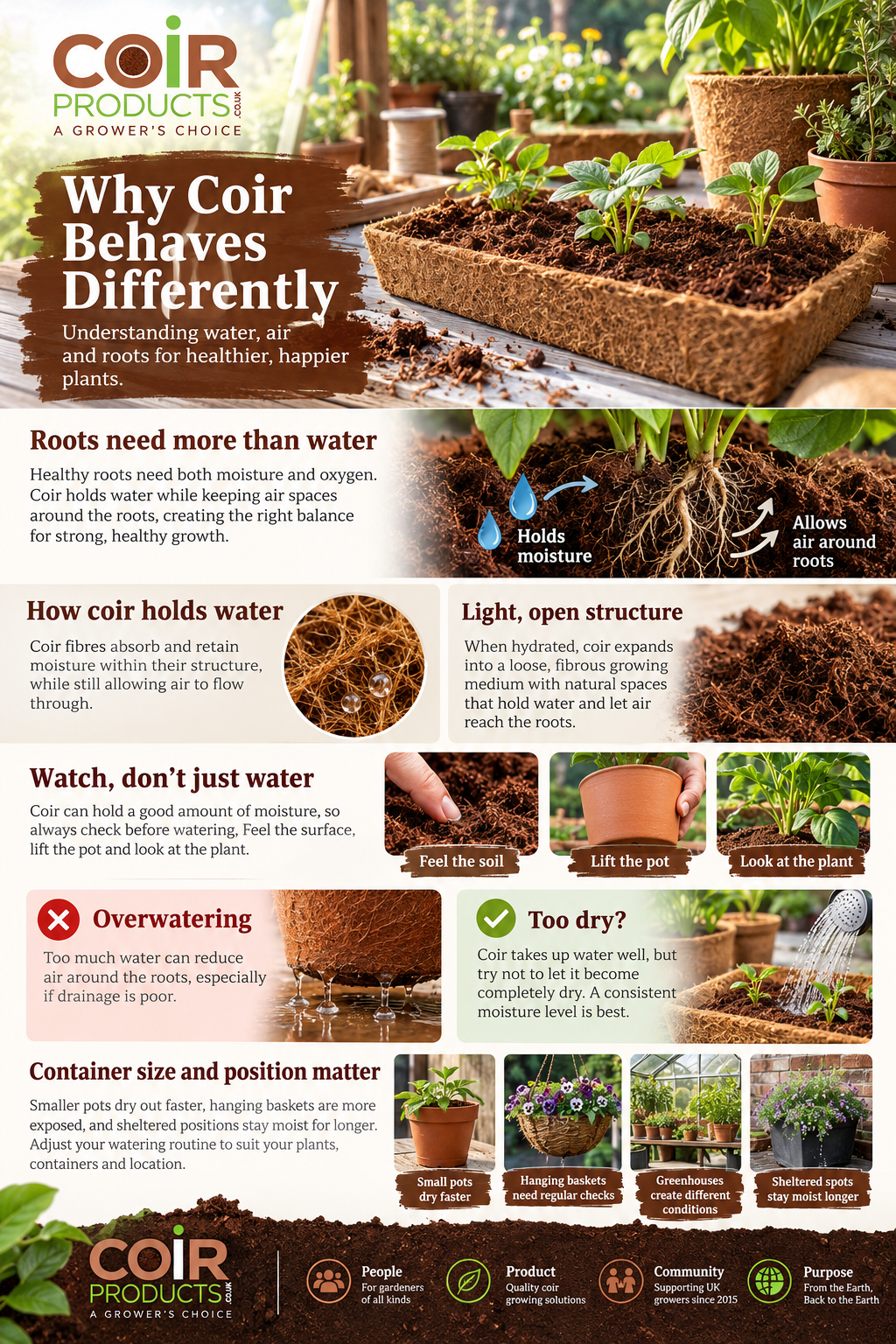
Roots need more than water
It is easy to think of a growing medium simply as something that holds a plant upright and stores water between visits with the watering can.
There is rather more going on beneath the surface.
Healthy roots need access to both moisture and oxygen. If a growing medium becomes excessively compacted or remains saturated for prolonged periods, the balance around the root zone can change.
Equally, a medium that dries too quickly can leave the gardener constantly trying to catch up.
One of the reasons coir has become such a useful growing material is its physical structure. When properly prepared and used, the fibres create spaces within the growing medium that can retain moisture while also allowing air around developing roots.
It is this relationship between moisture retention and aeration that makes coir interesting to growers.
Why does coir feel different?
Anyone using a compressed Coir Vital Grow® brick for the first time will notice the transformation.
A relatively compact block is hydrated and gradually opens into a loose growing medium.
It is one of those gardening jobs that still feels surprisingly satisfying, however many times you’ve done it.
But the expansion isn’t merely about producing more material.
The structure that develops as the coir loosens is important. Rather than becoming a dense mass, properly hydrated coir has a light, fibrous character with numerous small spaces throughout it.
Some of those spaces hold moisture. Others help air move through the root zone.
That distinction matters.
Don’t treat coir exactly like traditional compost
This is probably one of the most useful pieces of advice we can give someone trying coir for the first time.
Watch the plant and the growing medium rather than automatically following your old watering routine.
Coir can hold a considerable amount of moisture, so watering simply because you would normally water on that particular day isn’t always necessary.
Check first.
Feel below the surface. Lift smaller pots and learn how their weight changes as moisture is used. Look at the plant itself.
Very quickly, you begin to understand the rhythm of the growing medium.
Gardening has always involved observation. Coir is no different.
What happens when you overwater?
Coir’s ability to retain moisture is useful, but it doesn’t mean more water is always better.
Roots still require oxygen.
Repeatedly adding water when the growing medium is already sufficiently moist can reduce the amount of air available within the root zone, particularly where drainage is poor.
That is why the container matters too.
Make sure pots and planters have suitable drainage and avoid leaving plants permanently sitting in excess water unless the particular plant requires those conditions.
The aim isn’t to keep coir constantly wet.
It is to maintain a useful balance between moisture and air.
And when coir becomes too dry?
Coir is remarkably good at taking up water again, but there is little advantage in repeatedly allowing plants to become severely dry before soaking them.
A more consistent approach is usually preferable.
During warmer periods, containers may need checking frequently. As autumn progresses and temperatures fall, plants generally use water more slowly.
That makes October a particularly good time to reconsider summer watering habits.
A pot that needed attention almost every day during a hot spell in July may behave very differently on a cool October morning.
The calendar has changed. Your watering should probably change with it.
Container size makes a difference
A small pot and a large planter can contain exactly the same growing medium and still require completely different watering routines.
Smaller containers have less volume and can respond quickly to changes in temperature.
Larger containers generally contain a greater reserve of moisture, although the plants growing in them may also have considerably larger root systems.
Then there is position.
A container beside a sheltered wall may remain moist considerably longer than one exposed to wind. A greenhouse creates different conditions again. Hanging baskets are particularly exposed and should be checked accordingly.
There is no substitute for actually looking at what is happening in your growing space.
Coir and nutrients: an important distinction
Water is only part of successful growing.
Plants also need the appropriate nutrition.
This is where it is important to understand which type of coir product you are using rather than assuming that every bag or brick works in precisely the same way.
Within the CoirProducts® range, we have products designed for different growing requirements, including plain coir growing media and products with added nutrients.
If you are using a growing medium without added plant nutrition, an appropriate feeding programme may be required depending on what you are growing and at what stage.
It sounds obvious, but it is something worth checking before planting.
Read the product, understand what is in it, and grow accordingly.
Why gardeners keep returning to coir
We have been working with coir in the UK since 2015, long before it became a familiar sight across online gardening shops and marketplaces.
Over those years we’ve supplied first-time gardeners, experienced growers, allotment holders, houseplant enthusiasts and people who simply wanted to try something different in their garden.
Their growing spaces couldn’t be more varied.
That experience has reinforced something we have believed from the beginning: a good growing product shouldn’t make gardening unnecessarily complicated.
It should help create the conditions in which roots can establish and plants can grow.
Understanding how water and air behave within coir is a small part of that — but an important one.
From the Earth, Back to the Earth
Coir begins with something wonderfully simple: the husk surrounding a coconut.
Through careful processing, that fibrous material can become potting mixes, propagation products, pots, trays, grow bags, hanging basket liners, mulch products and many of the other things gardeners use every day.
For us, that connection between material and growing has always been at the heart of CoirProducts®.
From the Earth, Back to the Earth.
Not as a passing slogan, but as a way of thinking about the products we develop and the role they play in people’s gardens.
People. Product. Community. Purpose.
Eleven years in this market has taught us that gardening isn’t really about products sitting on shelves.
It is about what people do with them.
The first seedling on a windowsill. Tomatoes taking over the greenhouse. A child planting something for the first time. The allotment that never quite looks finished. The houseplant collection that somehow becomes twice the size it was last year.
Those are the things that matter.
And they are why the next chapter of CoirProducts® is being built around four simple ideas:
People • Product • Community • Purpose
Good products matter. Knowledge matters. But so does the community of people actually using them.
That is what has kept us learning, developing and growing alongside UK gardeners since 2015.
 Share:

Leave a Reply