
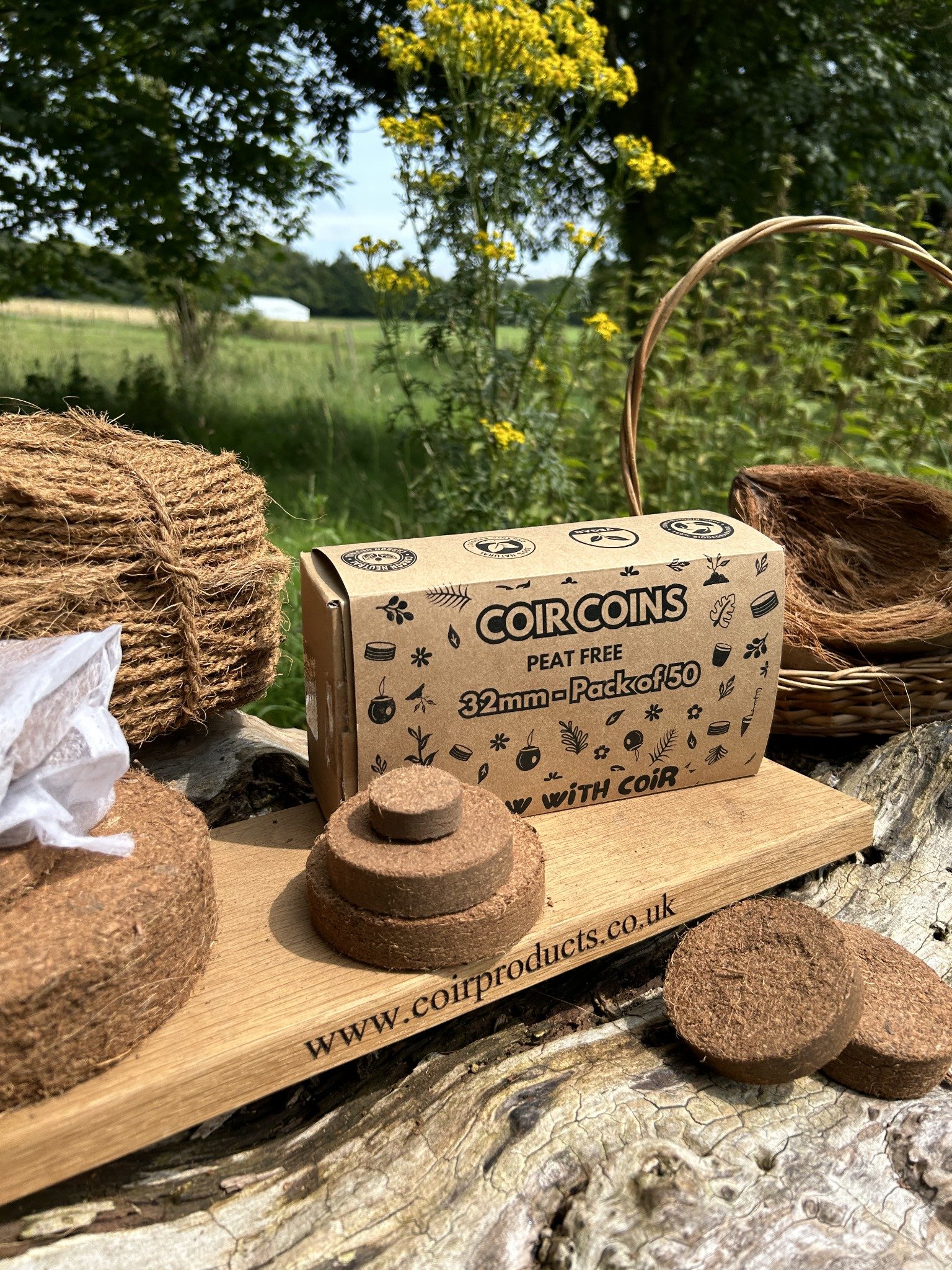
If you have bought a houseplant, grown vegetables, lined a hanging basket or started seeds in recent years, there is a fair chance you have already encountered coir.
Sometimes it is obvious: a compressed brown block waiting to be soaked in water. Sometimes it is a plant pot, a mulch mat or the fibrous covering around a climbing pole.
But what actually is coir?
It is a question we are asked surprisingly often.
And after working with coir in the UK for more than eleven years, we think it deserves a better answer than simply calling it an alternative growing medium.
Coir starts with the coconut husk
A coconut has several layers. The hard shell most of us recognise sits inside a thick, fibrous outer husk.
It is this husk that gives us coir.
Once processed, different parts of the material can be separated and prepared for different uses. The finer material is particularly useful in growing media, while the longer fibres can be used in products such as plant pots, basket liners, mulch products and plant supports.
This versatility is one of the reasons we became interested in coir in the first place.
The same raw material can perform very different jobs around the garden.
Why is coir used for growing plants?
Roots need more than water.
They also need access to air, somewhere to establish themselves and growing conditions that do not swing unnecessarily between being saturated and completely dry.
This is where the physical structure of coir becomes useful.
Properly prepared coir can hold a considerable amount of moisture while retaining air spaces within the growing medium. It also has good drainage characteristics.
In simple terms, it can provide a useful balance between water, air and structure around the root zone.
That makes coir suitable for a wide range of growing situations, from houseplants and containers to vegetables, greenhouse growing and propagation.
It is not magic. It is simply a very useful material when understood and used properly.
Is coir the same as compost?
Not necessarily and this is one of the most important things to understand when buying coir.
A standard coir growing medium and a conventional nutrient-rich compost are not automatically the same thing.
Coir provides the physical environment in which roots grow, but standard coir does not necessarily provide all of the nutrition a plant requires.
For example, our Coir Vital Grow® is designed as a coir growing medium. Depending on what you are growing, appropriate plant nutrition should be supplied as required.
Other products are formulated differently.
CoirPlus®, for example, combines coir with added NPK nutrients, while Coir Nutri® uses a different coir-based formulation with added plant nutrition.
This is why we encourage gardeners to look beyond the word coir on the front of a product.
Ask instead:
What exactly am I buying, and what has it been designed to do?
That is a much more useful question.
Why does coir come in compressed blocks?
One of the clever characteristics of coir growing media is that they can be compressed.
A dry block takes up relatively little space. Add water, give the material time to absorb it and then loosen it thoroughly, and the volume increases considerably.
Anyone who has hydrated a coir block for the first time will probably remember it.
There is something rather satisfying about watching a compact brick slowly soften, swell and turn into a large pile of usable growing medium.
But there is a practical reason for compression too.
It makes coir easier to store before it is required. A gardener can keep several blocks in a shed, greenhouse or garage without storing the equivalent volume as large bags of loose material.
When it is needed, hydrate it.
How do you prepare a coir block?
The principle is straightforward.
Place the block in a container large enough to accommodate the expanded material and gradually add water.
Give the coir time to absorb the moisture rather than flooding it unnecessarily. As the block begins to soften, break the material apart and continue working through it.
Once hydrated, loosen and fluff the coir thoroughly.
The exact quantity of water and final volume will vary according to the size and formulation of the product, so we always recommend following the instructions for the particular coir product you are using.
One of the most common mistakes is assuming every compressed coir product should be prepared in exactly the same way.
They shouldn’t.
Coir isn’t only for potting mixes
This is where coir becomes particularly interesting.
When people first discover CoirProducts®, they often associate us with our compressed growing media. But walk through our range and you begin to see how many different gardening jobs this one material can perform.
Coir pots provide containers for plants and propagation.
CoirCoins® provide small individual growing plugs for seeds and cuttings.
Coir grow poles provide a fibrous support for climbing houseplants such as Monstera, Pothos and Philodendron.
Coir mulch mats sit around plants and cover the surface of the growing medium.
Coir basket liners create the familiar natural lining used in hanging baskets and planters.
And coir fibre can be used in numerous other horticultural and landscaping applications.
That breadth is one of the reasons we have remained focused on coir for so long.
There is always another application to understand.
What should you look for when buying coir?
Price matters. Of course it does.
But it shouldn’t be the only thing you compare.
Look at what the product actually contains. Check whether nutrients have been added. Look at the stated size or expansion volume and read the preparation instructions.
Most importantly, choose the product according to what you intend to grow.
Someone repotting two houseplants does not need the same product or quantity as somebody preparing several raised beds.
Likewise, a gardener who wants control over their own feeding regime may make a different choice from someone who prefers a growing medium with nutrients already incorporated.
Good gardening products should make the job simpler, not make the purchasing decision more confusing.
Eleven years of learning about one material
Coir has become much more visible in British gardening over the past few years.
For us, however, it isn’t a new category.
CoirProducts® has specialised in coir products in the UK since 2015.
Over those eleven years we have seen how people actually use it.
We’ve answered the hydration questions. We’ve spoken to gardeners growing tomatoes, vegetables, houseplants and seedlings. We’ve seen customers move from one product to another as their gardens change. And we’ve developed a much broader range around the different jobs coir can perform.
That experience has also taught us something important:
there is no single “best” coir product for everybody.
There is a right product for the particular job.
Our job as a specialist is to help you find it.
So, is coir right for your plants?
Quite possibly.
If you want a growing medium with good moisture-holding, aeration and drainage characteristics, coir is certainly worth understanding.
But start with the plant rather than the product.
What are you growing? Where are you growing it? How will you feed it? How much growing medium do you need?
Answer those questions first and choosing the right coir product becomes considerably easier.
And if you’re unsure, ask us.
After eleven years working with coir, there aren’t many coir questions we haven’t heard although our customers do still manage to surprise us occasionally.
That’s part of the pleasure of working with growers.
CoirProducts® – Trusted by UK Growers Since 2015.
From the Earth. Back to the Earth.
 Share:


Leave a Reply