
There comes a point in the life of almost every houseplant when its once-generous pot begins to feel rather cramped.
Sometimes the signs are obvious: roots escaping from the bottom, a plant becoming increasingly top-heavy or water disappearing almost as quickly as you pour it in. At other times, a plant simply seems to have stopped thriving.
Repotting at the right moment gives roots fresh space and, just as importantly, an opportunity to reconsider the growing medium your houseplant is living in.
So, how do you know when the time has come?
1. Roots are growing through the drainage holes
This is perhaps the clearest indication. A few visible roots aren’t necessarily cause for alarm, but a substantial mass emerging beneath the pot usually suggests that the root system is running short of room.
2. The plant dries out remarkably quickly
If a pot that once remained comfortably moist for several days suddenly needs watering far more frequently, roots may now occupy much of the available space.
With less growing medium surrounding them, there is simply less capacity to retain moisture.
3. Water runs straight through the pot
Pour water onto the surface and it immediately appears in the saucer?
The growing medium may have become compacted or the plant may be sufficiently root-bound that water is finding channels around the root mass rather than distributing evenly.
4. Growth has slowed
Growth naturally varies with season, light and the type of plant. But if a healthy plant stops producing new growth during its normal growing period, restricted roots are one possibility worth investigating.
5. The plant is becoming top-heavy
Monstera, philodendrons and other substantial houseplants can eventually become rather ambitious for their containers.
If the plant frequently tips, leans or feels disproportionately large for its pot, it may be time for a larger container and potentially some additional support.
6. There are more roots than growing medium
Gently remove the plant from its pot and have a look.
If you find a dense network of circling roots with very little growing medium remaining between them, the plant has probably outgrown its present home.
7. The growing medium has become dense or tired
Repotting isn’t solely about pot size.
Over time, growing media can settle and their physical structure can change. If the material has become particularly dense, poorly draining or difficult to rehydrate evenly, replacing it may improve conditions around the roots.
8. Roots are appearing at the surface
Surface roots aren’t unusual in every species, but a sudden increase can indicate that the plant’s root system is becoming crowded.
Consider this alongside the plant’s overall condition rather than treating it as an automatic instruction to repot.
9. Your plant simply isn’t thriving
Yellowing leaves, wilting or disappointing growth can have numerous causes, so resist immediately reaching for a larger pot.
Check light, watering, temperature, pests and nutrition first. If those appear appropriate, examining the roots can tell you considerably more.
Choosing the right houseplant compost
A larger pot alone doesn’t make a happier houseplant.
The environment surrounding the roots matters enormously. A useful houseplant growing medium needs to balance moisture retention with sufficient air space and drainage.
That is one reason coir can be particularly useful.
Coir has a naturally open structure and can hold moisture while still helping maintain air around the root zone. Rather than becoming excessively heavy when wet, a well-formulated coir-based houseplant mix can provide the sort of structure many indoor plants appreciate.
But coir needn’t work alone.
Coir, biochar and charcoal: Why the ingredients matter
Different materials can be combined to create a more considered growing environment.
Coir provides the principal growing structure, helping balance moisture and aeration.
Biochar is a porous carbon-rich material which can contribute to the physical structure of a growing medium and provide surfaces within the mix where water, nutrients and microorganisms can interact.
Horticultural charcoal is also porous and can help create a more open growing medium when appropriately incorporated.
The important point is not to add fashionable ingredients simply because they sound impressive. A houseplant mix should be formulated so its components work together and suit the plants being grown.
That distinction matters.
DomusCoir®: Developed for indoor growing
At CoirProducts®, we’ve spent more than 11 years working with coir and developing coir growing products for the UK market.
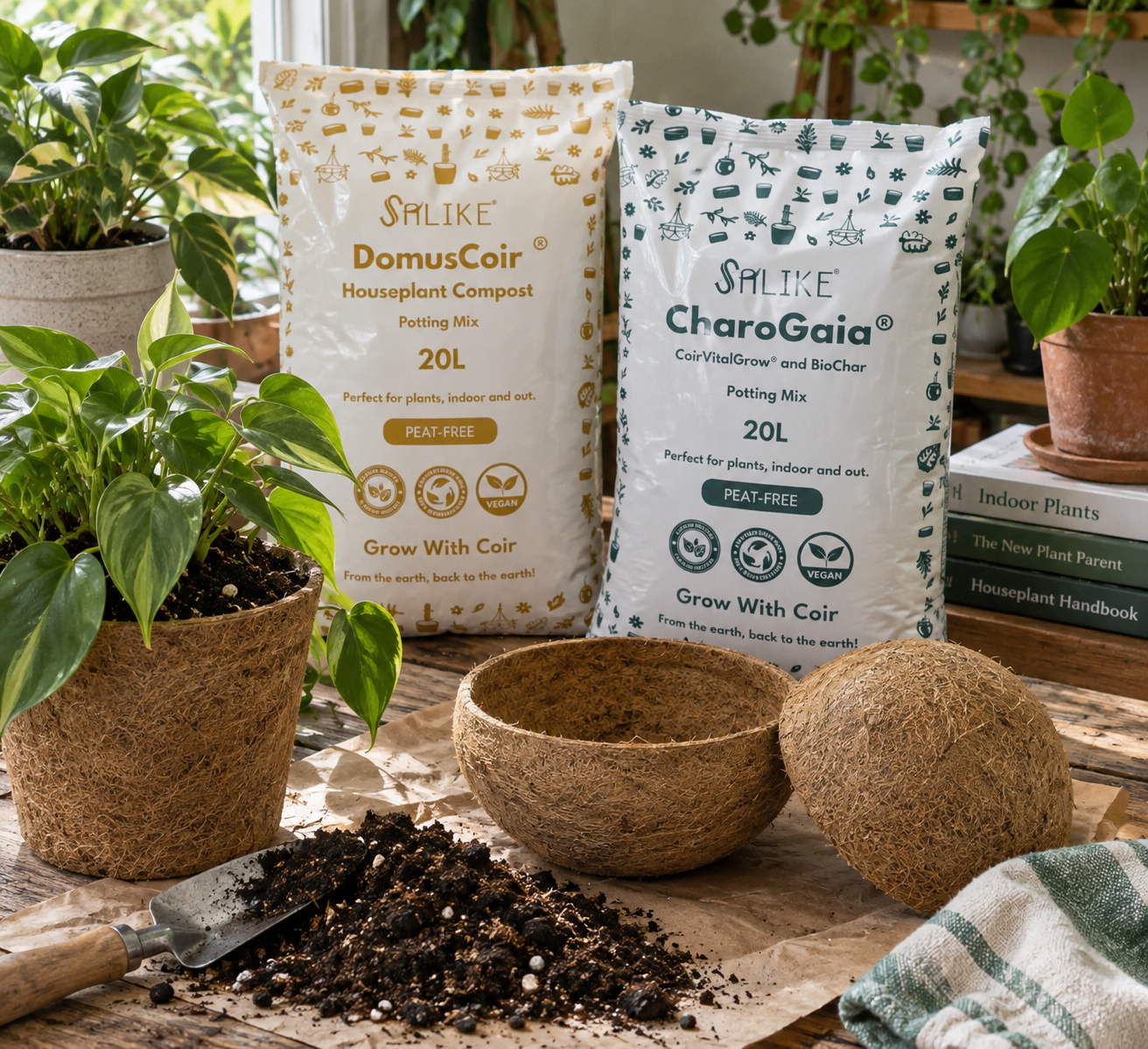
Our DomusCoir® Houseplant Growing Medium was developed specifically with indoor growing in mind, combining the qualities of coir with carefully selected complementary materials, including biochar and charcoal.
For us, houseplant growing media shouldn’t simply be ordinary multipurpose compost placed into a smaller bag. The root environment of a plant living permanently in a container deserves rather more thought than that.
And although choosing the right growing medium matters, so does choosing the right moment to repot.
Don’t automatically move a plant into an enormous container. In most cases, moving up one sensible pot size at a time is preferable. Ensure the new pot has appropriate drainage, gently inspect the roots and settle the plant into its new growing medium without excessively compacting it.
Then give it a little time.
A newly repotted houseplant doesn’t need endless attention. Sometimes the most useful thing a gardener can do is provide good conditions and allow the plant to get on with growing.
After all, a bigger pot is only part of the story. What you put inside it matters too.
 Share:

Leave a Reply