
Why Coir is Sustainable
Learning Objectives:
- Understand the environmental benefits of coir vs peat and synthetic growing media
- Learn about the coir lifecycle from coconut to compost
- Explore ethical sourcing, renewable cycles, and responsible manufacturing
- Gain awareness of how coir contributes to climate conscious gardening
What Does Sustainability Really Mean?
Before we dive into coir specifically, let’s define what sustainability means in a gardening context:
- Renewability: Can the resource regenerate?
- Low Environmental Impact: How much energy, water, or pollution is involved in sourcing/processing?
- Ethics: Are workers treated fairly? Are local ecosystems protected?
- End of Life: What happens to the product after use? Does it biodegrade or pollute?
Coir checks many of these boxes and in many cases, outperforms common alternatives like peat and synthetic media.
From Waste to Wonder: Coir’s Lifecycle
Step 1: Harvesting CoconutsCoconuts are harvested primarily for food, oil, and water. The husk which surrounds the inner nut used to be a waste by product.
Step 2: Extracting Coir FibresThe husk is soaked, beaten, or mechanically processed to extract coir pith and fibres.
Step 3: Drying & ScreeningThe coir pith is dried in the sun and screened for consistency. Sometimes it’s washed to reduce salt content.
Step 4: Compression & PackagingProcessed coir is compressed into blocks, discs, pots, or growbags and packaged usually with minimal plastic.
Step 5: Use in GardeningThe coir is rehydrated and used as a medium for growing everything from microgreens to trees.
Step 6: Biodegradation or ReuseUsed coir can be composted, reused in beds, or safely disposed of no landfill pollution.
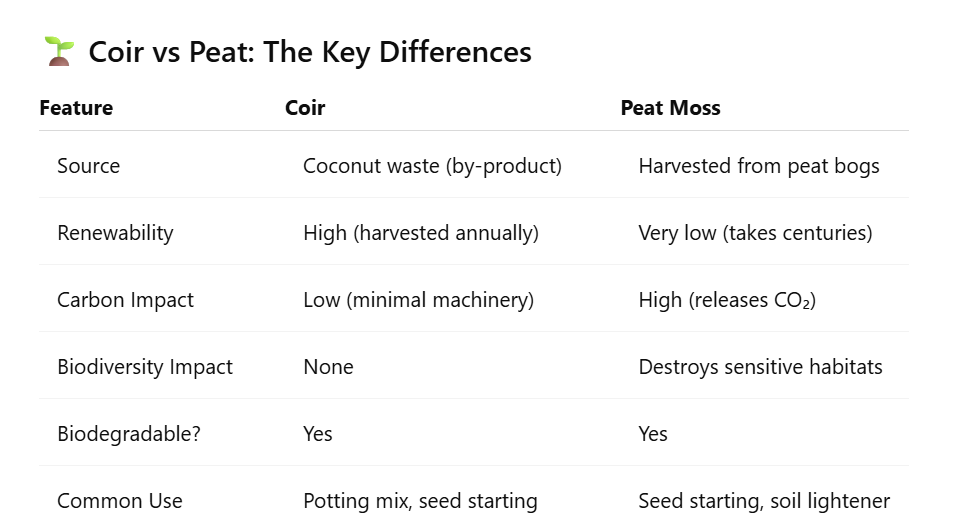
Coir offers a peat-free alternative that still performs well in water retention and soil structure improvement.
Renewable Resource with Long-Term Benefits
Coconuts are one of the world’s most sustainable crops:
- Grown in over 90 countries
- Trees bear fruit for 60–80 years
- Husk waste is abundant and otherwise discarded
- Requires less energy to process than other media (like perlite or rock wool)
By reusing coconut husk, the coir industry helps:
- Reduce agricultural waste
- Provide jobs in tropical countries
- Support circular economies
Water Usage, Carbon Emissions & Beyond
Many peat alternatives require significant processing. Coir generally involves:
- Sun drying (no ovens or artificial drying)
- Low fossil fuel use in processing
- Minimal water use in rehydration compared to producing rock wool
Key Fact: Harvesting 1 hectare of peat can release up to 500 tonnes of CO₂. Choosing coir instead helps offset this damage.
Ethical Considerations
- Fair Trade: Many coir suppliers are moving toward fair wages, better conditions, and support for local communities
- Plastic Free Packaging: Companies like Coir Products by Salike are reducing single use packaging
- Supply Chain Transparency: Leaders in the space are sharing how their coir is sourced and processed
Use this transparency as a measure of how ethical a coir product is.
Reflection Questions
- Had you heard of peat free gardening before this?
- Do you consider where your soil or growing media comes from?
- How might switching to coir help you reduce your carbon footprint?
- What matters more to you: performance or environmental impact?
Activities
Activity 1 – Trace Your Garden Media
- Look at your current compost or potting mix. Is it peat based? What’s in it?
- Research the source and environmental impact of your media.
Activity 2 – Make a Peat-Free Pledge
- Write your own commitment to going peat free. Share it on social media.
- Encourage your garden centre or school to offer peat free options.
Activity 3 – Timeline of a Coir Block Create a poster or digital graphic showing the journey from coconut to compost. Label each step and add icons/illustrations.
Activity 4 – Class Debate or Discussion “Peat vs Coir: Which Should We Choose?” Organise a friendly discussion and gather pros/cons for both sides.
Recap
Coir is far more than just a convenient growing medium. It is an example of how sustainability, innovation, and tradition can align in a single product. When you choose coir, you’re actively supporting:
- Renewable farming
- Reduced carbon emissions
- Waste upcycling
- Ethical supply chains
That’s a lot of power in a humble coconut husk.
Disclaimer: This article is provided for general information only and does not constitute engineering, environmental, design, legal, or professional advice. Project-specific advice should always be obtained from suitably qualified professionals.