
What is Coir?
- Explore its industrial and horticultural applications, past and present
- Examine why coir is transforming the growing industry as a sustainable alternative
Introduction to Coir
Coir is a natural fibre extracted from the husk of coconuts. While most people are familiar with coconut meat or water, few realise the tough, fibrous material between the hard shell and the outer skin (the mesocarp) is where coir comes from.
This fibrous layer is made of lignin and cellulose components that give it high durability, elasticity, and water retention. It has traditionally been discarded or used for rudimentary purposes, but over the last two decades, coir has emerged as a powerful, eco-friendly alternative in the gardening world.
Traditional Uses of Coir
Coir has a long standing history in South and Southeast Asia. Before its use in horticulture, coir fibres were widely used in:
- Rope and cordage: Strong, saltwater resistant ropes for ships
- Brushes and mats: Due to its rough texture
- Mattresses and upholstery: For natural springiness and resilience
- Doormats and sacks: Thick coir yarn provided insulation and friction
Even today, many traditional industries depend on coir craftsmanship, with entire villages in India, Sri Lanka, and the Philippines specialising in its production.
Coir in the Gardening Industry
In horticulture, the part used is typically coir pith (also called coco peat). This is the sponge like material that holds water well and promotes aeration.
Key horticultural uses of coir:
- Seed starting
- Soil less growing
- Hydroponic media
- Greenhouse growing
- Indoor potted plants
- Vertical gardening
Because coir retains moisture without becoming waterlogged, it helps roots breathe reducing problems like root rot, which is common in compacted or overwatered soils.
Scientific Composition of Coir
| Component | % by weight |
| Lignin | 25–45% |
| Cellulose | 30–40% |
| Hemicellulose | 0.15–0.25% |
| Moisture content | 8–10% (dry form) |
- Lignin: Makes coir highly durable and slow to decompose
- Cellulose: Contributes to fibrous texture and absorbency
Because of this composition, coir breaks down slowly making it reusable for 1–2 growing seasons depending on the application.
Why It Matters: Sustainability in Focus
Coir is a byproduct of the coconut industry, which is already harvesting coconuts for oil, milk, and water. Coir repurposes waste material into something highly valuable.
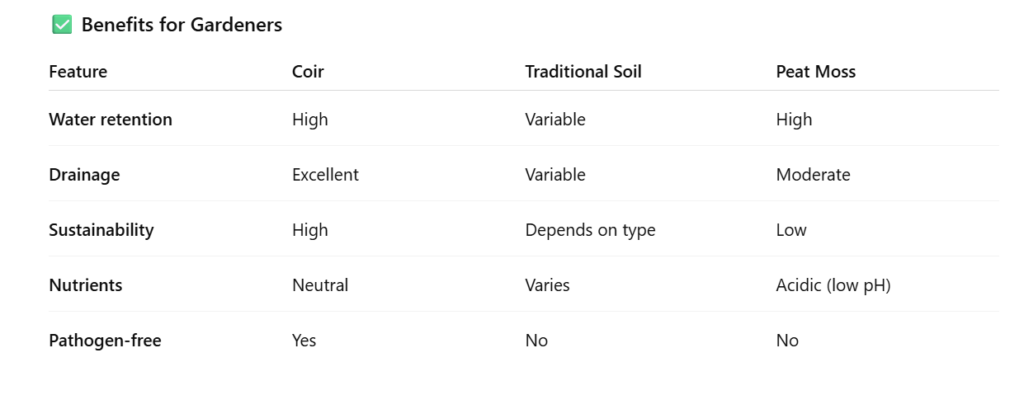
Compared to peat, which is dug from sensitive bog ecosystems, coir has the following benefits:
- Renewable and annually harvested
- Does not release carbon stores into the atmosphere
- Biodegradable and compostable
- Promotes circular economy in coconut farming nations
Benefits for GardenersLearning Objectives:
- Understand the botanical origin and natural structure of coir
Reflection Questions:
- What qualities make coir a good medium for beginners and professional growers alike?
- In your own words, how does coir support sustainable agriculture?
- Can you think of a non gardening product that uses coconut byproducts?
Activity Options:
Option A – Home Investigation:
- If you have a coir brick or disc at home, rehydrate it and observe how much it expands.
- Compare its texture, smell, and water retention to regular soil.
Option B – Industry Research:
- Search for three global brands using coir in innovative ways (e.g., erosion mats, green roofs, pet bedding).
- Note what forms of coir they use and how it differs from gardening applications.
Option C – Discussion Prompt:
- Join an online forum or garden community and ask: “Has anyone here switched from peat to coir? What was your experience?”
Recap:
You now understand what coir is, where it comes from, how it’s used in various industries, and why it’s fast becoming a key player in sustainable gardening. It is not just a growing medium it’s a movement.
Disclaimer: This article is provided for general information only and does not constitute engineering, environmental, design, legal, or professional advice. Project-specific advice should always be obtained from suitably qualified professionals.
- Explore its industrial and horticultural applications, past and present
- Examine why coir is transforming the growing industry as a sustainable alternative
Introduction to Coir
Coir is a natural fibre extracted from the husk of coconuts. While most people are familiar with coconut meat or water, few realise the tough, fibrous material between the hard shell and the outer skin (the mesocarp) is where coir comes from.
This fibrous layer is made of lignin and cellulose components that give it high durability, elasticity, and water retention. It has traditionally been discarded or used for rudimentary purposes, but over the last two decades, coir has emerged as a powerful, eco-friendly alternative in the gardening world.
Traditional Uses of Coir
Coir has a long standing history in South and Southeast Asia. Before its use in horticulture, coir fibres were widely used in:
- Rope and cordage: Strong, saltwater resistant ropes for ships
- Brushes and mats: Due to its rough texture
- Mattresses and upholstery: For natural springiness and resilience
- Doormats and sacks: Thick coir yarn provided insulation and friction
Even today, many traditional industries depend on coir craftsmanship, with entire villages in India, Sri Lanka, and the Philippines specialising in its production.
Coir in the Gardening Industry
In horticulture, the part used is typically coir pith (also called coco peat). This is the sponge like material that holds water well and promotes aeration.
Key horticultural uses of coir:
- Seed starting
- Soil less growing
- Hydroponic media
- Greenhouse growing
- Indoor potted plants
- Vertical gardening
Because coir retains moisture without becoming waterlogged, it helps roots breathe reducing problems like root rot, which is common in compacted or overwatered soils.
Scientific Composition of Coir
| Component | % by weight |
| Lignin | 25–45% |
| Cellulose | 30–40% |
| Hemicellulose | 0.15–0.25% |
| Moisture content | 8–10% (dry form) |
- Lignin: Makes coir highly durable and slow to decompose
- Cellulose: Contributes to fibrous texture and absorbency
Because of this composition, coir breaks down slowly making it reusable for 1–2 growing seasons depending on the application.
Why It Matters: Sustainability in Focus
Coir is a byproduct of the coconut industry, which is already harvesting coconuts for oil, milk, and water. Coir repurposes waste material into something highly valuable.
Compared to peat, which is dug from sensitive bog ecosystems, coir has the following benefits:
- Renewable and annually harvested
- Does not release carbon stores into the atmosphere
- Biodegradable and compostable
- Promotes circular economy in coconut farming nations
Benefits for GardenersLearning Objectives:
- Understand the botanical origin and natural structure of coir
Reflection Questions:
- What qualities make coir a good medium for beginners and professional growers alike?
- In your own words, how does coir support sustainable agriculture?
- Can you think of a non gardening product that uses coconut byproducts?
Activity Options:
Option A – Home Investigation:
- If you have a coir brick or disc at home, rehydrate it and observe how much it expands.
- Compare its texture, smell, and water retention to regular soil.
Option B – Industry Research:
- Search for three global brands using coir in innovative ways (e.g., erosion mats, green roofs, pet bedding).
- Note what forms of coir they use and how it differs from gardening applications.
Option C – Discussion Prompt:
- Join an online forum or garden community and ask: “Has anyone here switched from peat to coir? What was your experience?”
Recap:
You now understand what coir is, where it comes from, how it’s used in various industries, and why it’s fast becoming a key player in sustainable gardening. It is not just a growing medium it’s a movement.
Disclaimer: This article is provided for general information only and does not constitute engineering, environmental, design, legal, or professional advice. Project-specific advice should always be obtained from suitably qualified professionals.
Learning Objectives:
- Identify the different forms of coir used in gardening and growing
- Understand the properties and ideal use cases for each format
- Choose the right product based on gardening goals and environments
Introduction to Coir Product Forms
Coir comes in a range of formats not because it’s complicated, but because gardening is diverse. The plant you grow, the space you have, and your goals (e.g., starting seeds vs maintaining a large planter) all determine which coir product works best.
These formats have been designed for versatility, sustainability, and ease of use especially for beginners, families, schools, and even large-scale growers.
Product Profiles: In Detail
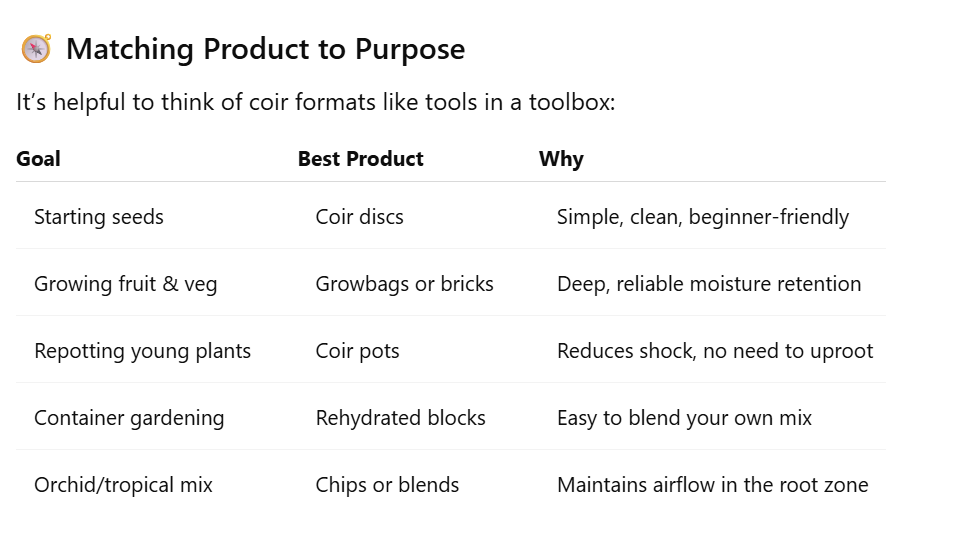
1. Coir Blocks & Bricks
- What They Are: Compressed blocks of coir pith, typically 650g to 5kg in weight.
- Use Case: Ideal for rehydration and mixing with compost or feeds. Often used in pots, beds, or planters.
- Benefits:
- Expand significantly when water is added (e.g., 5kg = ~80L)
- Long shelf life and easy to store
- Great base for creating your own potting mixes
- Best For: Intermediate to advanced gardeners, container gardening, raised beds
2. Coir Coins / Discs
- What They Are: Small, compressed discs that expand with water
- Use Case: Excellent for starting seeds indoors or in classrooms
- Benefits:
- Mess free
- Built in seed space
- Often wrapped in biodegradable mesh
- Best For: Beginners, children, schools, windowsill gardeners
3. Coir Pots & Trays
- What They Are: Moulded coir fibres formed into small pots and seedling trays
- Use Case: Plant directly into soil with the pot no need to disturb roots
- Benefits:
- Biodegradable and plantable
- Great for reducing transplant shock
- Encourages root pruning
- Best For: Growers concerned with plant health and sustainable materials
4. Growbags
- What They Are: Pre filled bags with coir for direct planting
- Use Case: Ready made media for tomatoes, strawberries, peppers
- Benefits:
- Clean, fast setup for patio or greenhouse use
- Ideal for fruiting crops that need deep, moisture rich roots
- Often come with water retention and drainage layers
- Best For: Balcony gardens, greenhouses, high yield crops
5. Coir Chips & Blends
- What They Are: Coarse chunks of coconut husk used for orchids or aeration
- Use Case: Potting orchids, bromeliads, or mixing with finer coir for airflow
- Benefits:
- Provides airflow and drainage
- Great for epiphytes and tropical plants
- Best For: Orchid lovers, indoor plant enthusiasts
Reflection Questions:
- Which format of coir do you think would be most useful in your growing space?
- Have you ever struggled with transplant shock could coir pots help reduce it?
- How might coir discs be useful for schools or teaching environments?
Activity 1 – Product Observation If you have a sample of more than one coir format (e.g., brick and disc), compare:
- Water absorption rate
- Ease of handling
- Texture and colour
Activity 2 – Use Case Mapping Draw a chart or infographic matching each plant (e.g., tomato, sunflower, strawberry, basil, orchid) to its ideal coir product.
Activity 3 – Product Selection Quiz Scenario: You’re starting a rooftop tomato garden. Which product(s) should you choose, and why?
Bonus Activity (For Kids or Families) Make a coir coin mini greenhouse using a plastic food container and a few coir discs. Track how long each seed takes to sprout.
Recap:
You’ve now explored the variety of coir-based products available, how they differ in use and structure, and how each one supports different growing goals. This knowledge helps you become not just a gardener but a more strategic, eco conscious grower.
Learning Objectives:
- Understand the environmental benefits of coir vs peat and synthetic growing media
- Learn about the coir lifecycle from coconut to compost
- Explore ethical sourcing, renewable cycles, and responsible manufacturing
- Gain awareness of how coir contributes to climate conscious gardening
What Does Sustainability Really Mean?
Before we dive into coir specifically, let’s define what sustainability means in a gardening context:
- Renewability: Can the resource regenerate?
- Low Environmental Impact: How much energy, water, or pollution is involved in sourcing/processing?
- Ethics: Are workers treated fairly? Are local ecosystems protected?
- End of Life: What happens to the product after use? Does it biodegrade or pollute?
Coir checks many of these boxes and in many cases, outperforms common alternatives like peat and synthetic media.
From Waste to Wonder: Coir’s Lifecycle
Step 1: Harvesting CoconutsCoconuts are harvested primarily for food, oil, and water. The husk which surrounds the inner nut used to be a waste by product.
Step 2: Extracting Coir FibresThe husk is soaked, beaten, or mechanically processed to extract coir pith and fibres.
Step 3: Drying & ScreeningThe coir pith is dried in the sun and screened for consistency. Sometimes it’s washed to reduce salt content.
Step 4: Compression & PackagingProcessed coir is compressed into blocks, discs, pots, or growbags and packaged usually with minimal plastic.
Step 5: Use in GardeningThe coir is rehydrated and used as a medium for growing everything from microgreens to trees.
Step 6: Biodegradation or ReuseUsed coir can be composted, reused in beds, or safely disposed of no landfill pollution.
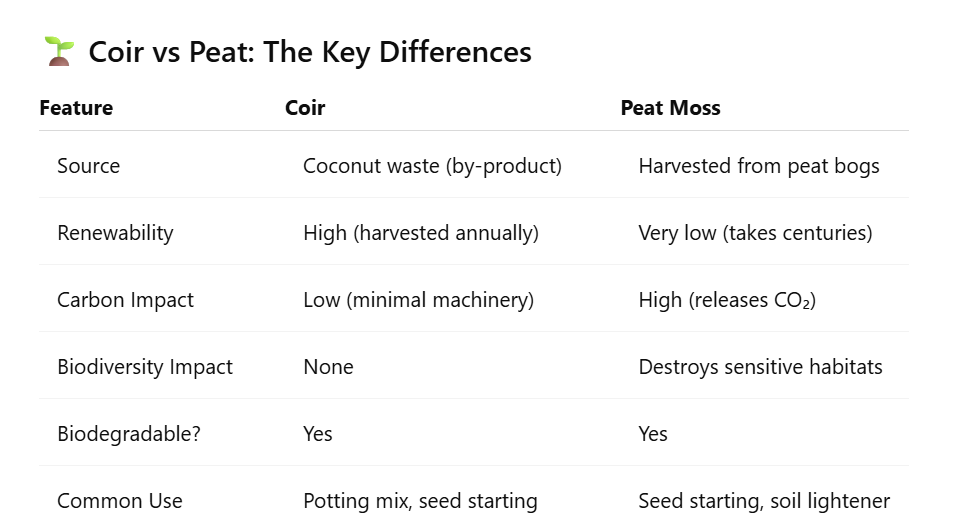
Coir offers a peat-free alternative that still performs well in water retention and soil structure improvement.
Renewable Resource with Long-Term Benefits
Coconuts are one of the world’s most sustainable crops:
- Grown in over 90 countries
- Trees bear fruit for 60–80 years
- Husk waste is abundant and otherwise discarded
- Requires less energy to process than other media (like perlite or rock wool)
By reusing coconut husk, the coir industry helps:
- Reduce agricultural waste
- Provide jobs in tropical countries
- Support circular economies
Water Usage, Carbon Emissions & Beyond
Many peat alternatives require significant processing. Coir generally involves:
- Sun drying (no ovens or artificial drying)
- Low fossil fuel use in processing
- Minimal water use in rehydration compared to producing rock wool
Key Fact: Harvesting 1 hectare of peat can release up to 500 tonnes of CO₂. Choosing coir instead helps offset this damage.
Ethical Considerations
- Fair Trade: Many coir suppliers are moving toward fair wages, better conditions, and support for local communities
- Plastic Free Packaging: Companies like Coir Products by Salike are reducing single use packaging
- Supply Chain Transparency: Leaders in the space are sharing how their coir is sourced and processed
Use this transparency as a measure of how ethical a coir product is.
Reflection Questions
- Had you heard of peat free gardening before this?
- Do you consider where your soil or growing media comes from?
- How might switching to coir help you reduce your carbon footprint?
- What matters more to you: performance or environmental impact?
Activities
Activity 1 – Trace Your Garden Media
- Look at your current compost or potting mix. Is it peat based? What’s in it?
- Research the source and environmental impact of your media.
Activity 2 – Make a Peat-Free Pledge
- Write your own commitment to going peat free. Share it on social media.
- Encourage your garden centre or school to offer peat free options.
Activity 3 – Timeline of a Coir Block Create a poster or digital graphic showing the journey from coconut to compost. Label each step and add icons/illustrations.
Activity 4 – Class Debate or Discussion “Peat vs Coir: Which Should We Choose?” Organise a friendly discussion and gather pros/cons for both sides.
Recap
Coir is far more than just a convenient growing medium. It is an example of how sustainability, innovation, and tradition can align in a single product. When you choose coir, you’re actively supporting:
- Renewable farming
- Reduced carbon emissions
- Waste upcycling
- Ethical supply chains
That’s a lot of power in a humble coconut husk.
Disclaimer: This article is provided for general information only and does not constitute engineering, environmental, design, legal, or professional advice. Project-specific advice should always be obtained from suitably qualified professionals.
Learning Objectives:
- Learn the practical steps to using coir-based products in home gardens and school environments
- Understand different formats and how to rehydrate or prepare them
- Discover educational, environmental, and hands on benefits of coir in everyday life
Getting Started with Coir at Home
Why coir is perfect for home gardening:
- Lightweight and easy to store (especially in compressed form)
- Clean, mess free alternative to heavy soil or compost
- Naturally pest and pathogen resistant
- Great water retention less watering needed
Common coir formats for home use:
- Coir Coins: Perfect for seed starting. Simply soak and sow.
- Coir Grow Bags: For tomatoes, chillies, and salad leaves.
- Coir Pots and Trays: Ideal for herbs or ornamental plants.
- Compressed Blocks: Can be used for containers, raised beds, or mixed with other media.
Step by Step: How to Prepare and Use Coir
- Hydrate Your Coir Block
- Place in a large container
- Add warm water gradually (4–5 litres per 1kg brick)
- Let it expand and fluff up takes about 15 minutes
- Mix (Optional)
- Add perlite, vermiculite, or worm castings to enrich
- Add slow release nutrients if growing high demand crops
- Plant
- Use in seed trays, containers, or mix into beds
- Monitor moisture coir retains water well, but don’t overwater
- Reuse or Compost
- Coir can be reused 2–3 times
- Compost the used coir or refresh by rebalancing nutrients
Using Coir in Schools
Why schools love coir:
- Peat free and planet-friendly
- Fun for hands on STEM learning
- Engages students in sustainability, science, and gardening
- Easy to store and distribute in packs
Popular school activities using coir:
- Grow from seed kits with coir coins and trays
- Build a bag garden with coir grow bags on trolleys
- Root observation projects using coir and clear pots
- Coir vs Soil water retention experiments
Reflection & Group Discussion Prompts
- What surprised you most about using coir instead of soil?
- How might coir gardening reduce your household or school’s environmental impact?
- If you were to recommend coir to a friend, what would you say?
- What challenges could you face using coir, and how might you solve them?
Activities
Activity 1 – Coir Hydration Challenge
- Try rehydrating a coir brick at home or in class
- Measure water input and expansion size
- Track how much water it retains over a week
Activity 2 – Start a Windowsill Garden
- Use coir pots and coir based compost
- Grow herbs like basil, coriander, or mint
- Keep a growth journal
Activity 3 – Science Fair Project: Coir vs Compost
- Test seedling growth in different media
- Document progress, take photos, measure height weekly
- Present your findings with graphs
Activity 4 – Design Your Own Coir Kit
- What would you include in a school coir kit?
- Design packaging, write instructions, and give it a fun name
Summary
Whether you’re a home gardener looking for eco friendly options or a teacher searching for educational tools, coir is a flexible, practical, and sustainable choice. From seed starting to science experiments, coir opens doors to hands on, planet friendly growing wherever you are.
Disclaimer: This article is provided for general information only and does not constitute engineering, environmental, design, legal, or professional advice. Project-specific advice should always be obtained from suitably qualified professionals.
Learning Objectives:
- Understand how coir compares with traditional and modern growing media
- Evaluate pros and cons of each based on growing needs
- Learn when and why to choose coir over alternatives
Common Growing Media Overview
- Peat Moss
- Traditionally used for decades
- High water retention, acidic pH (good for acid-loving plants)
- Environmental concerns: peat bogs take thousands of years to regenerate
- Coir Vital Grow potting mix®
- Crafted from coconut husk fiber (a waste by-product)
- Excellent water retention and aeration
- pH-neutral to slightly alkaline
- Reusable and biodegradable
- Compost
- Made from decomposed organic matter
- Rich in nutrients, helps build soil structure
- Can vary greatly in quality depending on source
- Perlite & Vermiculite
- Mined minerals used to improve aeration and drainage
- Inert, sterile, and lightweight
- Often mixed with coir or compost for better performance
- Hydroponic Substrates (Rockwool, Clay Pellets)
- Used in soilless systems
- Highly controlled environments
- Not biodegradable (e.g., rockwool)
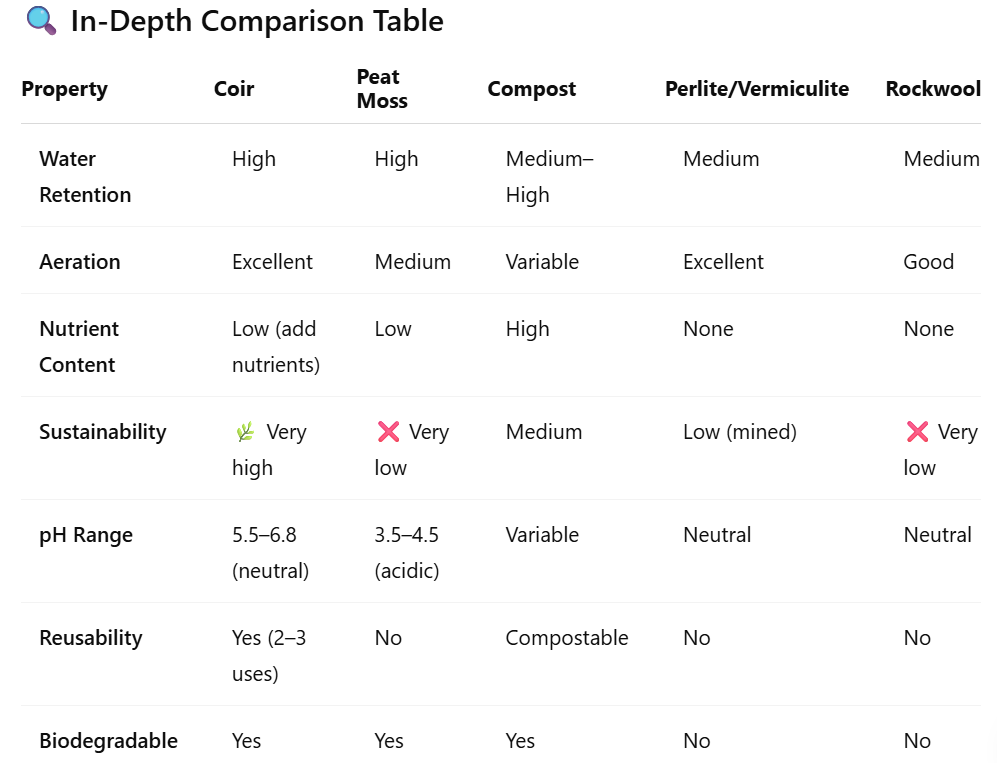
Key Takeaways
- Coir Vital Grow® potting mix offers the best balance between water retention, aeration, sustainability, and reusability.
- Peat moss is being phased out in many countries due to environmental impact.
- Compost is rich but can be inconsistent without proper control.
- In hydroponics or professional setups, coir + perlite is often a go-to combo.
Experiment – Which Media Performs Best?
Task:
- Grow radish or lettuce seeds in 3 different media: coir, compost, and peat moss
- Track germination speed, plant height, root length, and water usage for 3 weeks
- Record all data and create charts
Discussion Prompts:
- Which media supported the fastest growth?
- How did water retention vary?
- Were there any surprising differences in root structure?
Activity – Build Your Own Growing Mix
Goal: Create a custom blend based on a specific growing goal (e.g., herbs on a windowsill, tomatoes in grow bags, school growing kits).
- Choose a primary base (coir, compost, etc.)
- Add enhancers (perlite, worm castings, organic feed)
- Test texture, drainage, and feel
- Justify your mix in writing — why did you choose these ingredients?
Reflect & Share
- What surprised you about coir vs peat?
- Have you seen any media in your garden perform better or worse?
- If you could recommend a sustainable alternative to a gardener still using peat, what would you say?
Summary
Coir Vital Grow® potting mix stands out as the most sustainable, flexible, and user-friendly medium for modern growers. Compared to mined or non-renewable options like peat or rockwool, coir helps create better outcomes for plants and the planet. Understanding these comparisons gives you the confidence to choose consciously and grow responsibly.
Disclaimer: This article is provided for general information only and does not constitute engineering, environmental, design, legal, or professional advice. Project-specific advice should always be obtained from suitably qualified professionals.
Learning Objectives:
- Understand how coir is packaged and shipped
- Learn step by step how to rehydrate and break apart coir blocks or bricks
- Discover how to optimize coir for different uses (e.g., seedlings, pots, raised beds)
What You Get When You Buy Coir
Most coir products come compressed:
- Blocks/Bricks (650g or 5kg): Compact, dry, lightweight ideal for shipping
- Discs/Coins: Perfect for seed starting or individual pots
- Loose or Buffered Coir: Ready to use, often pre hydrated or mixed
These require hydration before use. A 5kg block can expand up to 80 litres of growing media once fully hydrated.
How to Hydrate Coir Step by Step
What You Need:
- A large bucket or container (minimum 30L for a 5kg block)
- Warm water (helps speed up the process)
- Optional: Gardening gloves, garden fork or hand rake
Steps:
- Place the coir block in the container.
- Slowly pour water over the block (about 3–5 litres per kg of coir).
- Wait 15–30 minutes while the block absorbs water.
- Use your hands or a tool to break apart and fluff the fibres.
- Add more water gradually until the texture feels like a damp sponge moist but not dripping.
Tips:
- If your water is hard or high in salts, consider using filtered water.
- Use a gardening fork to speed up loosening.
- You can enrich the coir by adding organic nutrients at this stage (like worm tea or seaweed feed).
Optional Enhancements Post-Hydration
Depending on your goal, mix coir with:
- Perlite or vermiculite for added drainage
- Compost or worm castings for nutrients
- Slow-release organic fertiliser if growing veggies or fruits
Proportions can vary:
- Seedlings: 60% coir + 40% vermiculite/perlite
- Veggies: 50% coir + 30% compost + 20% perlite
- Houseplants: 70% coir + 20% compost + 10% charcoal
Troubleshooting Hydration Issues
Problem: Coir still dry in the middle
Solution: Break the block apart and rehydrate in smaller chunks.
Problem: Waterlogged texture
Solution: Drain excess water and mix in perlite or dry coir to balance moisture.
Problem: Unpleasant smell
Solution: Coir should smell earthy. If sour, it may be anaerobic ensure it’s well-aerated and not overwatered.
Knowledge Check Mini Quiz
- What’s the typical water to coir ratio for hydration?
a) 1L per kg
b) 3–5L per kg
c) 10L per kg - What’s one benefit of adding perlite to coir?
- What does coir feel like when it’s properly hydrated?
(Answers: 1-b, 2-Improves aeration/drainage, 3-Like a damp sponge)
Activity – Rehydrate and Mix Your Own Growing Medium
Goal: Create a custom coir based growing blend.
- Hydrate a coir brick and track how much water it takes.
- Test different mixes for seed starting vs potting.
- Observe water retention and texture.
- Share your recipe with a photo and reflection.
Reflect & Share
- Was hydrating coir easier or harder than expected?
- What surprised you about the expansion volume?
- What other ways can you imagine using rehydrated coir in your home or classroom?
Summary
Hydrating and preparing coir is a simple but essential step that unlocks its full potential. Whether you’re sowing seeds, growing vegetables, or using it for houseplants or school gardens, mastering this process helps ensure healthy plant growth and an efficient, eco-conscious setup.
Disclaimer: This article is provided for general information only and does not constitute engineering, environmental, design, legal, or professional advice. Project-specific advice should always be obtained from suitably qualified professionals.
Learning Objectives:
- Learn best practices for growing in coir, from seed to harvest
- Understand how coir affects watering, fertilising, and root development
- Identify signs of healthy plant growth and potential issues
Why Coir is Great for Growing
Coir is highly versatile ideal for:
- Seed starting (holds moisture, prevents damping off)
- Container gardening (lightweight and root friendly)
- Hydroponics (stable pH and inert structure)
- Raised beds or vertical gardens
Its neutral pH, natural antifungal properties, and excellent moisture retention create a perfect base for many types of plants.
Tip #1: Moisture Management
Coir retains moisture well but also drains effectively. This means:
- Water less frequently than peat, but more often than heavy compost
- Check by feel coir should stay moist but not soggy
- Use containers with drainage holes
Pro tip: Stick your finger 2–3 cm into the coir. If it feels dry, it’s time to water.
Tip #2: Nutrient Strategy
Coir contains no inherent nutrients this is both a challenge and a benefit:
- You control the nutrition from day one
- It doesn’t interfere with your feeding schedule
Suggestions:
- For seedlings: Use a gentle organic feed or compost tea
- For veggies/fruits: Use a balanced feed (e.g., NPK 5-5-5 or 10-10-10)
- Reapply nutrients every 1–2 weeks or as plants indicate
Tip #3: Pairing Coir with Other Ingredients
Enhance performance by blending:
- Coir + compost for added nutrition
- Coir + perlite for better drainage
- Coir + worm castings for microbial life
Example mix:
- Tomatoes: 50% coir, 30% compost, 20% perlite
- Herbs: 60% coir, 20% sand, 20% compost
Signs of Success vs Trouble
Healthy signs:
- Strong roots visible at container edges
- Steady, upright growth
- Soil feels light and fluffy
Trouble signs:
- Yellow leaves = overwatering or nutrient imbalance
- Mushy stems = too wet
- Slow growth = underfeeding or compacted medium
Activity: Test, Tweak, Grow
Task: Start a small experiment.
- Grow the same plant in 100% coir, 50/50 coir compost, and 50/50 coir perlite
- Record growth rate, moisture levels, and overall appearance
- Reflect on what each mix offers
Knowledge Check
- Does coir contain natural nutrients? (No)
- What’s one benefit of adding compost to coir? (Adds nutrients)
- How can you tell when to water coir-based mixes?
(Answers: 1 – No, 2 – Nutrition, 3 – Finger test for dryness)
Reflect & Share
- How has coir changed your growing routine?
- What blend works best for your needs?
- Any success stories using coir vs traditional compost?
Summary
Growing in coir is both beginner-friendly and expert approved. Once you understand its unique moisture and nutrient needs, you can unlock healthier plants, stronger roots, and more sustainable results. Coir gives growers more control, less waste, and better outcomes in homes, gardens, or schools.
Disclaimer: This article is provided for general information only and does not constitute engineering, environmental, design, legal, or professional advice. Project-specific advice should always be obtained from suitably qualified professionals.
Learning Objectives:
- Learn the practical steps to using coir-based products in home gardens and school environments
- Understand different formats and how to rehydrate or prepare them
- Discover educational, environmental, and hands on benefits of coir in everyday life
Getting Started with Coir at Home
Why coir is perfect for home gardening:
- Lightweight and easy to store (especially in compressed form)
- Clean, mess free alternative to heavy soil or compost
- Naturally pest and pathogen resistant
- Great water retention less watering needed
Common coir formats for home use:
- Coir Coins: Perfect for seed starting. Simply soak and sow.
- Coir Grow Bags: For tomatoes, chillies, and salad leaves.
- Coir Pots and Trays: Ideal for herbs or ornamental plants.
- Compressed Blocks: Can be used for containers, raised beds, or mixed with other media.
Step by Step: How to Prepare and Use Coir
- Hydrate Your Coir Block
- Place in a large container
- Add warm water gradually (4–5 litres per 1kg brick)
- Let it expand and fluff up takes about 15 minutes
- Mix (Optional)
- Add perlite, vermiculite, or worm castings to enrich
- Add slow release nutrients if growing high demand crops
- Plant
- Use in seed trays, containers, or mix into beds
- Monitor moisture coir retains water well, but don’t overwater
- Reuse or Compost
- Coir can be reused 2–3 times
- Compost the used coir or refresh by rebalancing nutrients
Using Coir in Schools
Why schools love coir:
- Peat free and planet-friendly
- Fun for hands on STEM learning
- Engages students in sustainability, science, and gardening
- Easy to store and distribute in packs
Popular school activities using coir:
- Grow from seed kits with coir coins and trays
- Build a bag garden with coir grow bags on trolleys
- Root observation projects using coir and clear pots
- Coir vs Soil water retention experiments
Reflection & Group Discussion Prompts
- What surprised you most about using coir instead of soil?
- How might coir gardening reduce your household or school’s environmental impact?
- If you were to recommend coir to a friend, what would you say?
- What challenges could you face using coir, and how might you solve them?
Activities
Activity 1 – Coir Hydration Challenge
- Try rehydrating a coir brick at home or in class
- Measure water input and expansion size
- Track how much water it retains over a week
Activity 2 – Start a Windowsill Garden
- Use coir pots and coir based compost
- Grow herbs like basil, coriander, or mint
- Keep a growth journal
Activity 3 – Science Fair Project: Coir vs Compost
- Test seedling growth in different media
- Document progress, take photos, measure height weekly
- Present your findings with graphs
Activity 4 – Design Your Own Coir Kit
- What would you include in a school coir kit?
- Design packaging, write instructions, and give it a fun name
Summary
Whether you’re a home gardener looking for eco friendly options or a teacher searching for educational tools, coir is a flexible, practical, and sustainable choice. From seed starting to science experiments, coir opens doors to hands on, planet friendly growing wherever you are.
Disclaimer: This article is provided for general information only and does not constitute engineering, environmental, design, legal, or professional advice. Project-specific advice should always be obtained from suitably qualified professionals.
Learning Objectives:
- Understand how coir compares with traditional and modern growing media
- Evaluate pros and cons of each based on growing needs
- Learn when and why to choose coir over alternatives
Common Growing Media Overview
- Peat Moss
- Traditionally used for decades
- High water retention, acidic pH (good for acid-loving plants)
- Environmental concerns: peat bogs take thousands of years to regenerate
- Coir Vital Grow potting mix®
- Crafted from coconut husk fiber (a waste by-product)
- Excellent water retention and aeration
- pH-neutral to slightly alkaline
- Reusable and biodegradable
- Compost
- Made from decomposed organic matter
- Rich in nutrients, helps build soil structure
- Can vary greatly in quality depending on source
- Perlite & Vermiculite
- Mined minerals used to improve aeration and drainage
- Inert, sterile, and lightweight
- Often mixed with coir or compost for better performance
- Hydroponic Substrates (Rockwool, Clay Pellets)
- Used in soilless systems
- Highly controlled environments
- Not biodegradable (e.g., rockwool)
Key Takeaways
- Coir Vital Grow® potting mix offers the best balance between water retention, aeration, sustainability, and reusability.
- Peat moss is being phased out in many countries due to environmental impact.
- Compost is rich but can be inconsistent without proper control.
- In hydroponics or professional setups, coir + perlite is often a go-to combo.
Experiment – Which Media Performs Best?
Task:
- Grow radish or lettuce seeds in 3 different media: coir, compost, and peat moss
- Track germination speed, plant height, root length, and water usage for 3 weeks
- Record all data and create charts
Discussion Prompts:
- Which media supported the fastest growth?
- How did water retention vary?
- Were there any surprising differences in root structure?
Activity – Build Your Own Growing Mix
Goal: Create a custom blend based on a specific growing goal (e.g., herbs on a windowsill, tomatoes in grow bags, school growing kits).
- Choose a primary base (coir, compost, etc.)
- Add enhancers (perlite, worm castings, organic feed)
- Test texture, drainage, and feel
- Justify your mix in writing — why did you choose these ingredients?
Reflect & Share
- What surprised you about coir vs peat?
- Have you seen any media in your garden perform better or worse?
- If you could recommend a sustainable alternative to a gardener still using peat, what would you say?
Summary
Coir Vital Grow® potting mix stands out as the most sustainable, flexible, and user-friendly medium for modern growers. Compared to mined or non-renewable options like peat or rockwool, coir helps create better outcomes for plants and the planet. Understanding these comparisons gives you the confidence to choose consciously and grow responsibly.
Disclaimer: This article is provided for general information only and does not constitute engineering, environmental, design, legal, or professional advice. Project-specific advice should always be obtained from suitably qualified professionals.
Learning Objectives:
- Understand how coir is packaged and shipped
- Learn step by step how to rehydrate and break apart coir blocks or bricks
- Discover how to optimize coir for different uses (e.g., seedlings, pots, raised beds)
What You Get When You Buy Coir
Most coir products come compressed:
- Blocks/Bricks (650g or 5kg): Compact, dry, lightweight ideal for shipping
- Discs/Coins: Perfect for seed starting or individual pots
- Loose or Buffered Coir: Ready to use, often pre hydrated or mixed
These require hydration before use. A 5kg block can expand up to 80 litres of growing media once fully hydrated.
How to Hydrate Coir Step by Step
What You Need:
- A large bucket or container (minimum 30L for a 5kg block)
- Warm water (helps speed up the process)
- Optional: Gardening gloves, garden fork or hand rake
Steps:
- Place the coir block in the container.
- Slowly pour water over the block (about 3–5 litres per kg of coir).
- Wait 15–30 minutes while the block absorbs water.
- Use your hands or a tool to break apart and fluff the fibres.
- Add more water gradually until the texture feels like a damp sponge moist but not dripping.
Tips:
- If your water is hard or high in salts, consider using filtered water.
- Use a gardening fork to speed up loosening.
- You can enrich the coir by adding organic nutrients at this stage (like worm tea or seaweed feed).
Optional Enhancements Post-Hydration
Depending on your goal, mix coir with:
- Perlite or vermiculite for added drainage
- Compost or worm castings for nutrients
- Slow-release organic fertiliser if growing veggies or fruits
Proportions can vary:
- Seedlings: 60% coir + 40% vermiculite/perlite
- Veggies: 50% coir + 30% compost + 20% perlite
- Houseplants: 70% coir + 20% compost + 10% charcoal
Troubleshooting Hydration Issues
Problem: Coir still dry in the middle
Solution: Break the block apart and rehydrate in smaller chunks.
Problem: Waterlogged texture
Solution: Drain excess water and mix in perlite or dry coir to balance moisture.
Problem: Unpleasant smell
Solution: Coir should smell earthy. If sour, it may be anaerobic ensure it’s well-aerated and not overwatered.
Knowledge Check Mini Quiz
- What’s the typical water to coir ratio for hydration?
a) 1L per kg
b) 3–5L per kg
c) 10L per kg - What’s one benefit of adding perlite to coir?
- What does coir feel like when it’s properly hydrated?
(Answers: 1-b, 2-Improves aeration/drainage, 3-Like a damp sponge)
Activity – Rehydrate and Mix Your Own Growing Medium
Goal: Create a custom coir based growing blend.
- Hydrate a coir brick and track how much water it takes.
- Test different mixes for seed starting vs potting.
- Observe water retention and texture.
- Share your recipe with a photo and reflection.
Reflect & Share
- Was hydrating coir easier or harder than expected?
- What surprised you about the expansion volume?
- What other ways can you imagine using rehydrated coir in your home or classroom?
Summary
Hydrating and preparing coir is a simple but essential step that unlocks its full potential. Whether you’re sowing seeds, growing vegetables, or using it for houseplants or school gardens, mastering this process helps ensure healthy plant growth and an efficient, eco-conscious setup.
Disclaimer: This article is provided for general information only and does not constitute engineering, environmental, design, legal, or professional advice. Project-specific advice should always be obtained from suitably qualified professionals.
Learning Objectives:
- Understand how coir is packaged and shipped
- Learn step by step how to rehydrate and break apart coir blocks or bricks
- Discover how to optimize coir for different uses (e.g., seedlings, pots, raised beds)
What You Get When You Buy Coir
Most coir products come compressed:
- Blocks/Bricks (650g or 5kg): Compact, dry, lightweight ideal for shipping
- Discs/Coins: Perfect for seed starting or individual pots
- Loose or Buffered Coir: Ready to use, often pre hydrated or mixed
These require hydration before use. A 5kg block can expand up to 80 litres of growing media once fully hydrated.
How to Hydrate Coir Step by Step
What You Need:
- A large bucket or container (minimum 30L for a 5kg block)
- Warm water (helps speed up the process)
- Optional: Gardening gloves, garden fork or hand rake
Steps:
- Place the coir block in the container.
- Slowly pour water over the block (about 3–5 litres per kg of coir).
- Wait 15–30 minutes while the block absorbs water.
- Use your hands or a tool to break apart and fluff the fibres.
- Add more water gradually until the texture feels like a damp sponge moist but not dripping.
Tips:
- If your water is hard or high in salts, consider using filtered water.
- Use a gardening fork to speed up loosening.
- You can enrich the coir by adding organic nutrients at this stage (like worm tea or seaweed feed).
Optional Enhancements Post-Hydration
Depending on your goal, mix coir with:
- Perlite or vermiculite for added drainage
- Compost or worm castings for nutrients
- Slow-release organic fertiliser if growing veggies or fruits
Proportions can vary:
- Seedlings: 60% coir + 40% vermiculite/perlite
- Veggies: 50% coir + 30% compost + 20% perlite
- Houseplants: 70% coir + 20% compost + 10% charcoal
Troubleshooting Hydration Issues
Problem: Coir still dry in the middle
Solution: Break the block apart and rehydrate in smaller chunks.
Problem: Waterlogged texture
Solution: Drain excess water and mix in perlite or dry coir to balance moisture.
Problem: Unpleasant smell
Solution: Coir should smell earthy. If sour, it may be anaerobic ensure it’s well-aerated and not overwatered.
Knowledge Check Mini Quiz
- What’s the typical water to coir ratio for hydration?
a) 1L per kg
b) 3–5L per kg
c) 10L per kg - What’s one benefit of adding perlite to coir?
- What does coir feel like when it’s properly hydrated?
(Answers: 1-b, 2-Improves aeration/drainage, 3-Like a damp sponge)
Activity – Rehydrate and Mix Your Own Growing Medium
Goal: Create a custom coir based growing blend.
- Hydrate a coir brick and track how much water it takes.
- Test different mixes for seed starting vs potting.
- Observe water retention and texture.
- Share your recipe with a photo and reflection.
Reflect & Share
- Was hydrating coir easier or harder than expected?
- What surprised you about the expansion volume?
- What other ways can you imagine using rehydrated coir in your home or classroom?
Summary
Hydrating and preparing coir is a simple but essential step that unlocks its full potential. Whether you’re sowing seeds, growing vegetables, or using it for houseplants or school gardens, mastering this process helps ensure healthy plant growth and an efficient, eco-conscious setup.
Disclaimer: This article is provided for general information only and does not constitute engineering, environmental, design, legal, or professional advice. Project-specific advice should always be obtained from suitably qualified professionals.
Learning Objectives:
- Learn best practices for growing in coir, from seed to harvest
- Understand how coir affects watering, fertilising, and root development
- Identify signs of healthy plant growth and potential issues
Why Coir is Great for Growing
Coir is highly versatile ideal for:
- Seed starting (holds moisture, prevents damping off)
- Container gardening (lightweight and root friendly)
- Hydroponics (stable pH and inert structure)
- Raised beds or vertical gardens
Its neutral pH, natural antifungal properties, and excellent moisture retention create a perfect base for many types of plants.
Tip #1: Moisture Management
Coir retains moisture well but also drains effectively. This means:
- Water less frequently than peat, but more often than heavy compost
- Check by feel coir should stay moist but not soggy
- Use containers with drainage holes
Pro tip: Stick your finger 2–3 cm into the coir. If it feels dry, it’s time to water.
Tip #2: Nutrient Strategy
Coir contains no inherent nutrients this is both a challenge and a benefit:
- You control the nutrition from day one
- It doesn’t interfere with your feeding schedule
Suggestions:
- For seedlings: Use a gentle organic feed or compost tea
- For veggies/fruits: Use a balanced feed (e.g., NPK 5-5-5 or 10-10-10)
- Reapply nutrients every 1–2 weeks or as plants indicate
Tip #3: Pairing Coir with Other Ingredients
Enhance performance by blending:
- Coir + compost for added nutrition
- Coir + perlite for better drainage
- Coir + worm castings for microbial life
Example mix:
- Tomatoes: 50% coir, 30% compost, 20% perlite
- Herbs: 60% coir, 20% sand, 20% compost
Signs of Success vs Trouble
Healthy signs:
- Strong roots visible at container edges
- Steady, upright growth
- Soil feels light and fluffy
Trouble signs:
- Yellow leaves = overwatering or nutrient imbalance
- Mushy stems = too wet
- Slow growth = underfeeding or compacted medium
Activity: Test, Tweak, Grow
Task: Start a small experiment.
- Grow the same plant in 100% coir, 50/50 coir compost, and 50/50 coir perlite
- Record growth rate, moisture levels, and overall appearance
- Reflect on what each mix offers
Knowledge Check
- Does coir contain natural nutrients? (No)
- What’s one benefit of adding compost to coir? (Adds nutrients)
- How can you tell when to water coir-based mixes?
(Answers: 1 – No, 2 – Nutrition, 3 – Finger test for dryness)
Reflect & Share
- How has coir changed your growing routine?
- What blend works best for your needs?
- Any success stories using coir vs traditional compost?
Summary
Growing in coir is both beginner-friendly and expert approved. Once you understand its unique moisture and nutrient needs, you can unlock healthier plants, stronger roots, and more sustainable results. Coir gives growers more control, less waste, and better outcomes in homes, gardens, or schools.
Disclaimer: This article is provided for general information only and does not constitute engineering, environmental, design, legal, or professional advice. Project-specific advice should always be obtained from suitably qualified professionals.
Learning Objectives:
- Understand where coir is sourced and how it’s processed globally
- Explore the socioeconomic importance of coir production in different countries
- Learn how coir enters international trade and impacts the horticultural sector
Where Coir Comes From
Coir originates primarily from tropical regions with abundant coconut production. Major producers include:
- Sri Lanka – known for high quality brown and white coir
- India – especially Kerala and Tamil Nadu
- Philippines – rising coir export sector
- Indonesia, Thailand, and Vietnam – emerging coir exporters
These countries have the warm, humid climates ideal for coconut palms. Coir is a valuable by product of the coconut industry, using material that would otherwise go to waste.
How It’s Processed
Processing methods vary by region and product type. Key steps include:
- Harvesting: Mature coconuts are collected
- Retting: Husks are soaked in water to loosen fibers (natural or mechanical)
- Decorticating: Machines separate fibers from pith
- Drying & Screening: Coir is sun-dried and sorted into different grades
- Compressing: Coir is formed into bricks, blocks, coins, or grow bags for shipping
Some processing plants are highly mechanised, while others still use traditional hand methods.
Coir and Local Communities
The coir industry provides essential employment and income in rural areas:
- In India and Sri Lanka, coir supports thousands of small scale farmers, processors, and artisans
- Women’s cooperatives are common in processing hubs coir empowers women and supports community development
- Many eco-entrepreneurs have built sustainable businesses around coir exports
Using coir isn’t just sustainable for the planet it’s also an ethical, people-focused choice.
Global Trade and Export
Coir is exported worldwide in bulk and retail ready formats:
- Growers and garden centres in the UK, US, EU, and Australia are major importers
- Coir is sold as a peat-free alternative and also used in hydroponics, landscaping, and erosion control
- Quality standards and supply chain traceability are becoming increasingly important
Top Coir Export Products:
- Coir pith (bricks, blocks)
- Coir fibre (mats, ropes, brushes)
- Value added formats (grow cubes, seedling trays)
Environmental & Economic Impact
The growth in coir trade reflects global shifts:
- Peat bans in gardening markets are increasing demand
- Climate change awareness drives consumers to sustainable options
- Circular economy practices promote use of waste materials like coconut husk
While the coir industry is growing, there are still challenges:
- Balancing quality and cost
- Ensuring ethical sourcing
- Minimising carbon footprint in shipping
Knowledge Check
- Name three countries where coir is widely produced.
- What are the main steps in processing raw coir?
- How does coir impact rural communities in its countries of origin?
- Why is coir becoming more popular in global markets?
(Answers: 1 – India, Sri Lanka, Philippines; 2 – Harvesting, Retting, Decorticating, Drying, Compressing; 3 – Jobs, empowerment, cooperatives; 4 – Sustainability, peat bans, eco-awareness)
Activity: Coir Trade Tracker
Choose one country that exports coir. Research:
- How many people are employed in coir production?
- What kind of products are made there?
- Is it sustainably or ethically produced?
Prepare a short report or poster presentation.
Reflect & Share
- Did you realise your coir products had travelled so far?
- How do you feel knowing coir supports global livelihoods?
- Would you be more likely to choose brands that promote ethical sourcing?
Summary
Coir connects growers across continents. From the tropical farms of South Asia to your classroom windowsill or balcony planter, every block of coir has a journey. By choosing coir, we’re choosing not only a peat free growing medium but also a globally shared solution for sustainability, fairness, and innovation.
Disclaimer: This article is provided for general information only and does not constitute engineering, environmental, design, legal, or professional advice. Project-specific advice should always be obtained from suitably qualified professionals.
Learning Objectives:
- Address common challenges when using coir
- Learn best practices for resolving issues
- Understand how coir behaves differently from soil or peat
Common Questions & Clear Answers
Q1: Why is my coir drying out too fast?
A: Coir retains water well but if it’s over dried during storage or placed in a high-sun or windy area, it can dry quickly. Try mulching over it, using larger containers, or mixing with compost to help retain moisture.
Q2: Why is my coir staying too wet?
A: Coir needs good drainage. Make sure pots have holes and that you’re not overwatering. If mixed with heavy compost, it can retain more water than needed.
Q3: Does coir contain nutrients?
A: Coir is mostly inert. It doesn’t provide much nutrition on its own, so always add fertiliser suited to your plant type.
Q4: Can I use coir on its own?
A: Yes — especially for seed starting. But for long term growing, it’s best mixed with compost, worm castings, or natural fertilisers.
Q5: Why are my plants turning yellow in coir?
A: It could be a nutrient deficiency, usually nitrogen or iron. Ensure you are feeding your plants regularly. Coir doesn’t buffer nutrients like soil does.
Coir-Specific Challenges
pH Fluctuations
Coir is usually pH neutral or slightly acidic, which is great for most plants. However, some batches (especially low quality ones) can have salt build up or inconsistent pH. Use buffered coir from trusted sources.
Salt Residue
Cheap or unwashed coir can contain sodium or potassium salts. Always look for washed or buffered coir especially for sensitive plants.
Compaction Over Time
Coir may compact in pots over time. Fluff or remix with aerators like perlite or bark.
Activity: Coir Detective
Create a “troubleshooting log” for one plant growing in coir. Track:
- Watering frequency
- Fertiliser used
- Visible plant health changes
- Weather conditions
After 2 weeks, write down one change you made and whether it improved the plant’s health.
Reflect & Share
- What’s one mistake you’ve made with coir?
- How did you fix it?
- What’s something you now feel more confident about?
Summary
Like any growing medium, coir has a learning curve but once you understand its properties, it becomes a highly flexible, sustainable base for growing. Whether you’re troubleshooting moisture or feeding issues, knowing what to expect makes your coir journey more rewarding.
Disclaimer: This article is provided for general information only and does not constitute engineering, environmental, design, legal, or professional advice. Project-specific advice should always be obtained from suitably qualified professionals.
Learning Objectives:
- Understand how coir fits into the future of sustainable agriculture
- Explore innovations in coir based products and research
- Reflect on how coir use aligns with global challenges like climate change and soil degradation
The Next Generation of Growing Media
Coir has already transformed gardening and horticulture, but what lies ahead is even more exciting. As the pressure on traditional resources like peat intensifies, coir is stepping into a broader role not just as a substitute, but as a leader in growing innovation.
Key Future Trends:
- Bio-enhanced coir: Enriched with compost, microbes, and biochar
- Smart mixes: Tailored blends for cactus, orchids, hydroponics, vertical farming
- Circular systems: Using coir in closed loop agricultural models for better resource efficiency
- Automated coir systems: Used in robotic planters, smart greenhouses, and urban farms
Coir and the Climate Crisis
As climate events intensify, the role of growers and the media they use becomes more critical. Coir’s lower carbon footprint, renewability, and capacity to support regenerative agriculture means it’s well placed for the future.
Climate-Positive Features:
- Made from a waste product (coconut husk)
- Biodegradable and compostable
- Reduces demand for peat extraction and topsoil loss
- Supports water efficient gardening practices
Innovation in Coir
Cutting-edge research is improving coir’s consistency and performance. Labs are testing coir as a base for:
- Biodegradable plant pots and seedling trays
- Controlled release fertiliser systems
- Green construction materials
- Carbon sequestration biochar blends
In the UK, startups and educational projects like Grow with Coir are putting it in the hands of schools, families, and future farmers.
Coir in Urban and Indoor Farming
With limited space, city dwellers are turning to coir for:
- Balcony gardens
- Hydroponic kits
- Indoor houseplant mixes
- Rooftop greenhouses
Its lightweight, sterile nature and excellent water retention make it ideal for growing in compact environments.
Reflection & Activity: Your Growing Future
Imagine it’s the year 2035. How do you see coir being used where you live?
- Sketch your future garden or farm
- Write a short story or paragraph about a future grower using coir
- Interview a local gardener and ask how they think growing media will evolve
Discussion Prompts
- How can coir play a bigger role in solving food insecurity?
- What partnerships (schools, companies, governments) could support wider adoption?
- What challenges does the coir industry still face?
Summary
Coir isn’t just a trend it’s part of a global movement toward smarter, cleaner, and more regenerative ways to grow. From education to innovation, coir empowers everyone from backyard growers to commercial farms to make more sustainable choices.
By embracing coir, we’re growing more than plants we’re growing a better future.
Disclaimer: This article is provided for general information only and does not constitute engineering, environmental, design, legal, or professional advice. Project-specific advice should always be obtained from suitably qualified professionals.