
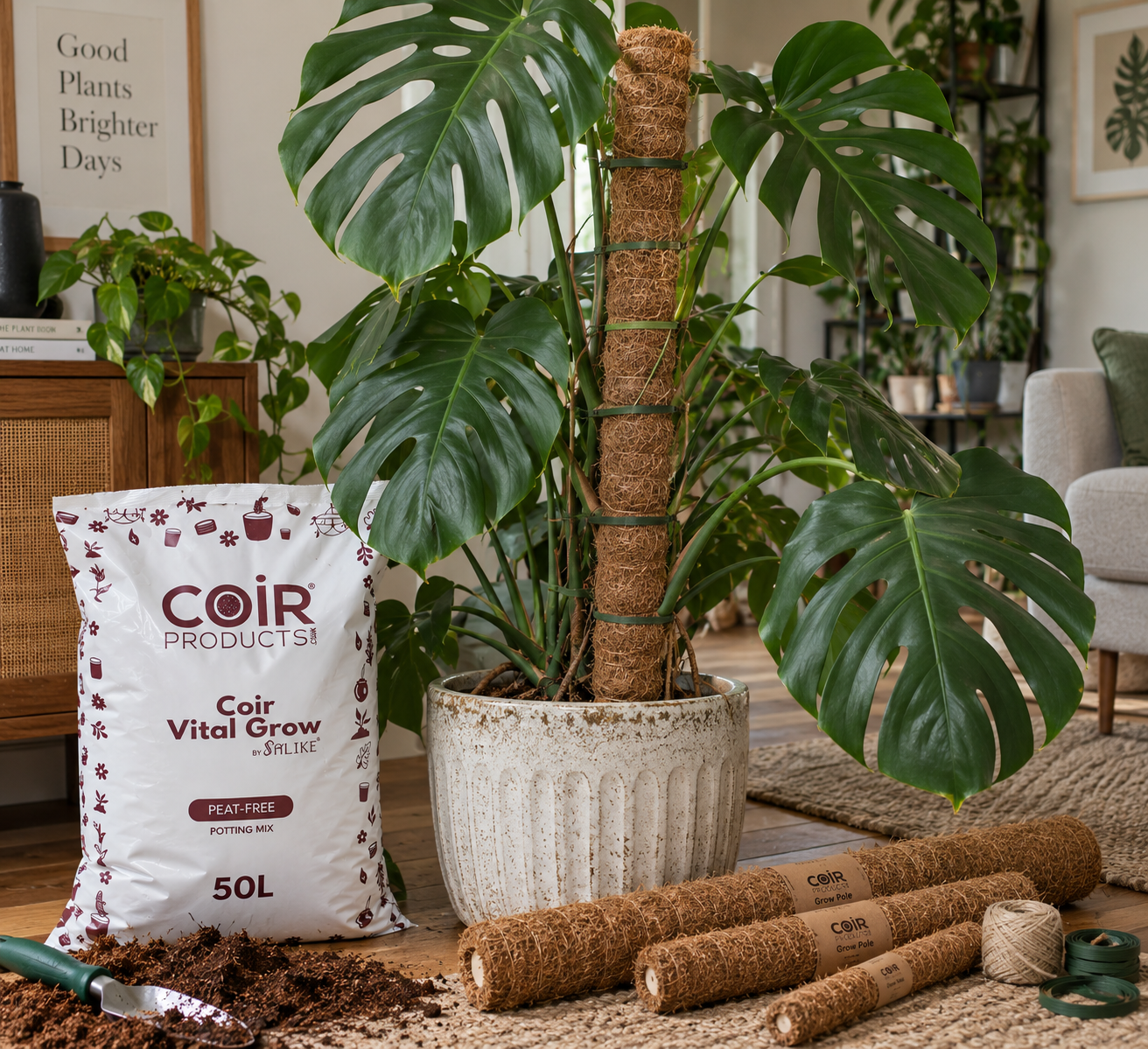
A healthy Monstera can be wonderfully unruly.
One year it sits quite politely in the corner of the room. The next, it has produced enormous leaves, sent aerial roots in several directions and appears intent upon occupying considerably more of the sitting room than originally agreed.
If your Monstera is falling over, leaning heavily to one side or sprawling across nearby furniture, there is probably nothing particularly wrong with it.
It may simply be behaving like a Monstera.
The solution is not necessarily a larger pot. What it often needs is proper support.
Why does a monstera start falling over?
Monsteras are climbing plants.
In their natural environment, they don’t generally grow as neat, self-supporting columns. They climb upwards using trees and other vegetation for support, attaching themselves as they grow.
Inside our homes, of course, there is usually no tree conveniently positioned beside the sofa.
Without something suitable to climb, a mature Monstera can begin leaning outwards. Larger leaves add considerable weight, stems become longer and the whole plant can gradually lose its shape.
This is where a plant support or coir grow pole becomes particularly useful.
1. Give your monstera something to climb
For larger Monsteras, a substantial vertical support is usually preferable to a collection of small stakes.
A coir grow pole provides a textured surface against which the plant can be positioned whilst encouraging a more upright growing habit.
At CoirProducts®, we offer Coir Grow Poles in several lengths, allowing you to choose a support appropriate to the size of the plant rather than forcing a mature Monstera onto a pole it will outgrow almost immediately.
[Explore CoirProducts® Coir Grow Poles →]
This is one occasion where thinking ahead pays dividends. If your Monstera is already growing vigorously, choosing sufficient height at the outset can save considerable rearranging later.
2. Position the pole properly
A grow pole works best when it is securely positioned.
Insert it sufficiently deeply into the growing medium so that it remains stable, taking care not to force it unnecessarily through a dense mass of roots.
Ideally, position the support towards the back of the plant, close to the main stems.
If you’re repotting at the same time, positioning the pole before settling the plant completely into its new pot is often considerably easier.
3. Bring the plant to the pole, gently
Don’t attempt to transform a sprawling Monstera into a perfectly upright specimen in five minutes.
Older stems may already have developed their own shape and can be damaged if forced too aggressively.
Instead, bring the main stems towards the support gradually and secure them loosely using soft plant ties.
The operative word is loosely.
The tie should support the stem, not squeeze it.
4. Pay attention to the aerial roots
Those long brown roots emerging from the stems aren’t a sign that your Monstera has gone terribly wrong.
They are part of the plant’s natural climbing behaviour.
Where practical, aerial roots can be gently directed towards the grow pole or growing medium. Avoid repeatedly cutting them simply because they look untidy.
A Monstera will always retain a certain amount of character. That is rather the point.
5. Check whether the pot is actually too small
A leaning Monstera does not automatically need a larger pot.
Before repotting, check the root system.
If roots are densely circling the pot, emerging substantially through the drainage holes or leaving very little growing medium remaining, moving up a pot size may be sensible.
If the roots still have adequate room, adding proper support may be all that is required.
Unnecessarily placing a plant into a vastly oversized pot can create its own problems, particularly around watering.
6. Think about the growing medium too
If you do decide to repot, it is worth considering what is going back around the roots.
Monsteras generally appreciate a growing environment that retains useful moisture without becoming excessively dense.
A well-structured houseplant growing medium can help maintain moisture whilst allowing air around the root zone.
Coir can be particularly useful here because of its combination of moisture retention and open structure.
[Explore CoirProducts® Houseplant Growing Media →]
Our houseplant range includes DomusCoir® Houseplant Compost as well as specialist coir-based formulations developed for container growing indoors.
7. Don’t forget the light
Support can improve the structure of a Monstera, but its position in the room matters too.
Plants naturally grow towards available light. If all the useful light is arriving from one direction, your Monstera may gradually lean towards it regardless of how handsome its new grow pole happens to be.
Bright, suitable indirect light and sensible positioning can help encourage more balanced growth.
What size grow pole does a monstera need?
This depends almost entirely upon the size of your plant.
A young Monstera may only require a modest support. An established floor-standing specimen needs something altogether more substantial.
As a general principle, don’t choose a pole based solely on how tall the plant is today. Consider where the next period of growth is going to go.
CoirProducts® Grow Poles are available in a range of sizes, including options suitable for larger climbing houseplants.
[Shop CoirProducts® Grow Poles →]
Supporting a monstera is about working with the plant
Perhaps the greatest mistake is trying to make a Monstera behave like a conventional upright houseplant.
It isn’t one.
Its instinct is to climb.
Give it suitable support, sufficient room, sensible light and a good growing environment, and much of the apparent unruliness begins to make sense.
At CoirProducts®, we’ve been working with coir products in the UK for more than 11 years, from growing media and pots to the coir supports used by climbing plants.
And if your Monstera is currently leaning precariously towards the television, don’t despair.
It probably doesn’t need disciplining. It simply needs something better to climb.
 Share:

Leave a Reply