
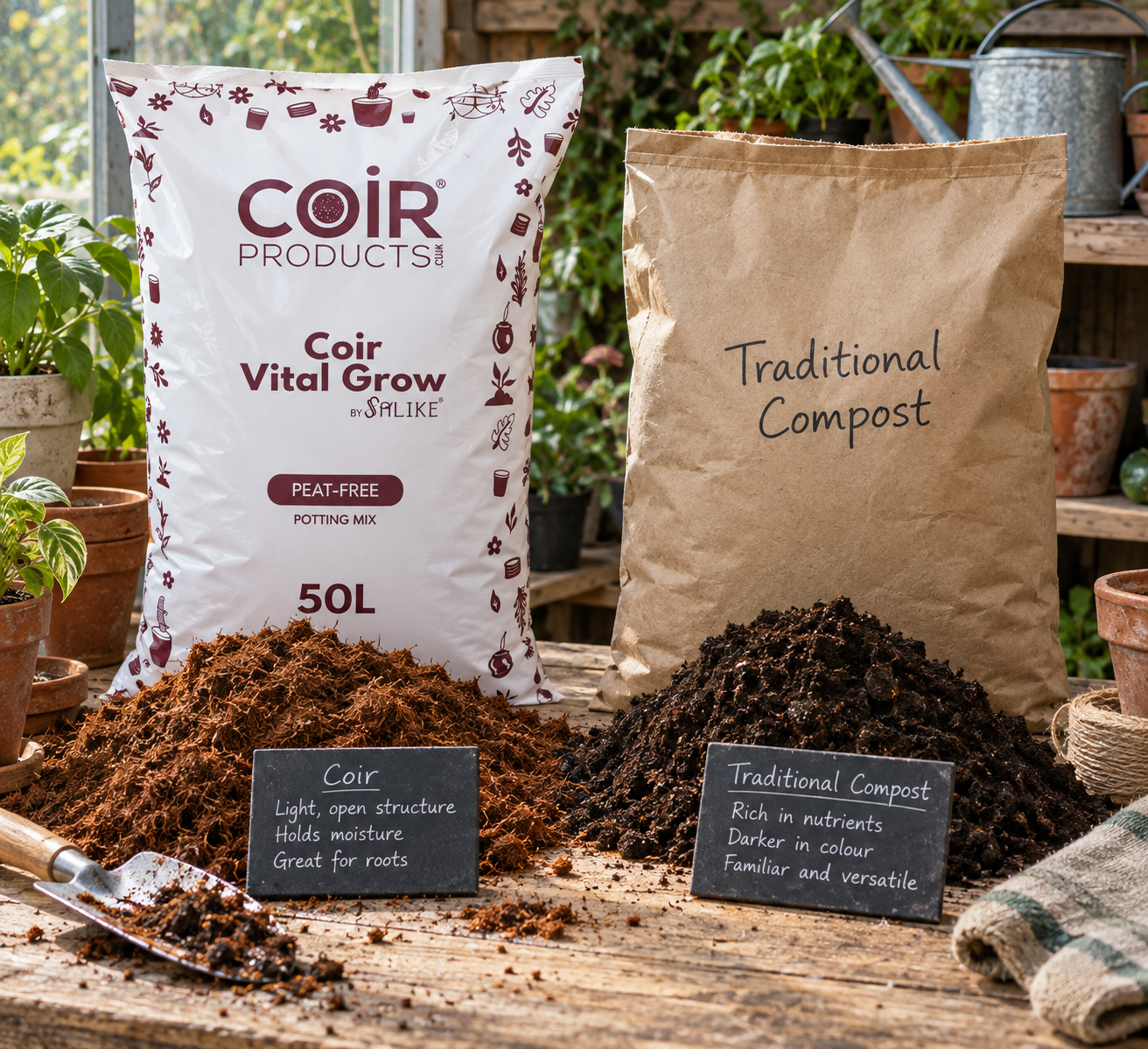
Walk into almost any garden centre and you will find bags of compost stacked in considerable numbers. For generations, buying a bag of compost has simply been part of gardening.
Coir has changed that conversation rather considerably.
Once regarded as something used mainly by commercial growers and particularly enthusiastic gardeners, coir is now finding its way into ordinary British gardens, greenhouses, allotments and homes.
But what actually is the difference between coir and traditional compost? And, more importantly, which should you use?
The answer is less about declaring one the winner and more about understanding what each material does.
What Is Traditional Compost?
The word compost is used rather broadly in gardening.
Traditional bagged multipurpose compost is usually a formulated growing medium made from a blend of materials. Depending upon the product, these might include composted green material, wood fibre, bark, peat or peat alternatives, together with added fertilisers and other ingredients.
It is designed to provide plants with a suitable environment for their roots while retaining sufficient moisture and, in many formulations, supplying some nutrition.
Garden compost is something slightly different again: the wonderfully useful material produced from decomposed garden and kitchen waste.
Neither should be confused with coir.
What Is Coir?
Coir is a natural fibrous material derived from the outer husk of coconuts.
For gardening purposes, it is processed into a growing material with a light, open structure. One of its most useful characteristics is its ability to hold moisture whilst maintaining air around the root zone.
It can be supplied loose, but compressed coir bricks are particularly convenient.
A relatively small brick can be stored until required and then hydrated with water, at which point it expands into a considerably larger quantity of growing medium.
For anyone who has wrestled an enormous bag of compost into the boot of a small car, the appeal isn’t difficult to understand.
Coir vs Compost: What Is the Main Difference?
The most important distinction is that coir is primarily a growing medium rather than a rich source of plant nutrition in its own right.
That matters.
Gardeners accustomed to opening a bag of conventional compost and planting immediately may assume that every growing medium works in precisely the same way.
It doesn’t.
Plain coir provides an excellent physical environment for roots, but plants will eventually require appropriate nutrition. This can be supplied separately or through a coir growing medium formulated with added nutrients.
At CoirProducts®, for example, we offer different coir formulations because a seedling, a houseplant and a hungry vegetable crop do not necessarily require exactly the same thing.
What About Watering?
This is where coir becomes particularly interesting.
A good growing medium needs to perform two jobs that might initially appear contradictory: hold useful moisture and allow sufficient air around the roots.
Coir is particularly valued for this balance.
Its fibrous structure can retain moisture without behaving like a dense, waterlogged mass when used correctly. At the same time, its structure provides pore spaces within the growing medium.
That does not mean plants grown in coir cannot be overwatered. They certainly can. Pot size, drainage, weather, plant type and watering habits all still matter.
There is no growing medium capable of rescuing every plant from an enthusiastic watering can.
Does Coir Compact Like Compost?
Growing media naturally change over time.
Some traditional composts can settle considerably as their organic components break down. Coir tends to maintain a useful structure around the roots, which is one reason it has become popular for containers and other situations where good root conditions are important.
Again, quality matters. Not every product labelled coir is identical, just as not every bag of compost is identical.
How the raw material has been processed, prepared and formulated makes a difference.
Does Coir Contain Fertiliser?
This is one of the questions we are asked most often.
Plain coir should not be assumed to contain all the nutrition a plant will require throughout its life.
That isn’t a disadvantage; in certain types of growing it is precisely what makes coir useful. It gives the grower greater control over nutrition.
For everyday gardening, however, convenience matters too.
That is why there are coir-based growing media with nutrients already incorporated. Within our own range, for example, we have developed different formulations for gardeners who want the physical qualities of coir with nutrition suited to particular growing requirements.
The important thing is simply to read what you are buying rather than assuming all coir products are interchangeable.
Can You Mix Coir with Compost?
Certainly.
It needn’t always be a question of coir versus compost.
Coir can form part of a wider growing mix, and gardeners often combine materials to achieve particular characteristics. Depending upon what you are growing, coir may be used alongside compost, perlite, bark, biochar or other horticultural ingredients.
Houseplants are a good example. Different plants appreciate different root environments, which is why specialist houseplant mixes increasingly contain combinations of materials rather than relying upon a single ingredient.
The purpose should always come before the recipe.
Which Is Better for Containers and GrowBags?
Coir is particularly well suited to container growing because of its combination of moisture retention and aeration.
It also lends itself rather neatly to GrowBags, where a compressed growing medium can be hydrated within a contained growing space before planting.
Tomatoes, cucumbers, aubergines, strawberries, herbs and many other plants can be grown using coir-based systems, provided their nutritional and watering requirements are properly considered.
Traditional compost remains perfectly useful for container gardening too.
The better question isn’t “Which one is universally better?”
It is:
“Which growing medium gives this particular plant the conditions it needs?”
That is a much more useful way to garden.
More Than 11 Years Working with Coir
At CoirProducts®, coir isn’t something we have recently added to a general gardening range.
We have been supplying and have the largest portfolio of coir based products in the UK for more than 11 years.
During that time, we’ve seen considerably greater interest in coir from home gardeners, allotment growers and houseplant enthusiasts. We’ve also seen the range of coir products available to consumers grow enormously.
That makes clear information increasingly important.
A compressed brick should not be judged solely by the largest litre figure on its packaging. A growing medium shouldn’t be chosen simply because one ingredient happens to be fashionable. And gardeners shouldn’t have to become horticultural scientists simply to repot a tomato plant.
Our approach has always been rather straightforward: understand what you’re growing, understand what is in your growing medium, and choose the product accordingly.
So, Should You Choose Coir or Traditional Compost?
There is room in a good garden shed for both.
Traditional compost remains familiar, convenient and suitable for an enormous range of gardening jobs. Coir offers something different: a lightweight, versatile growing medium with excellent moisture-management and aeration characteristics, particularly useful for pots, containers, GrowBags and specialist growing.
For some gardeners, the attraction will be its performance around the roots. For others, it will be the convenience of storing compressed bricks rather than bulky bags. And some simply prefer the degree of control that coir gives them over their growing medium and plant nutrition.
Whichever route you choose, look beyond the front of the bag.
Good growing begins below the surface. Understanding what your plants are actually growing in is a rather good place to start.
 Share:

Leave a Reply