
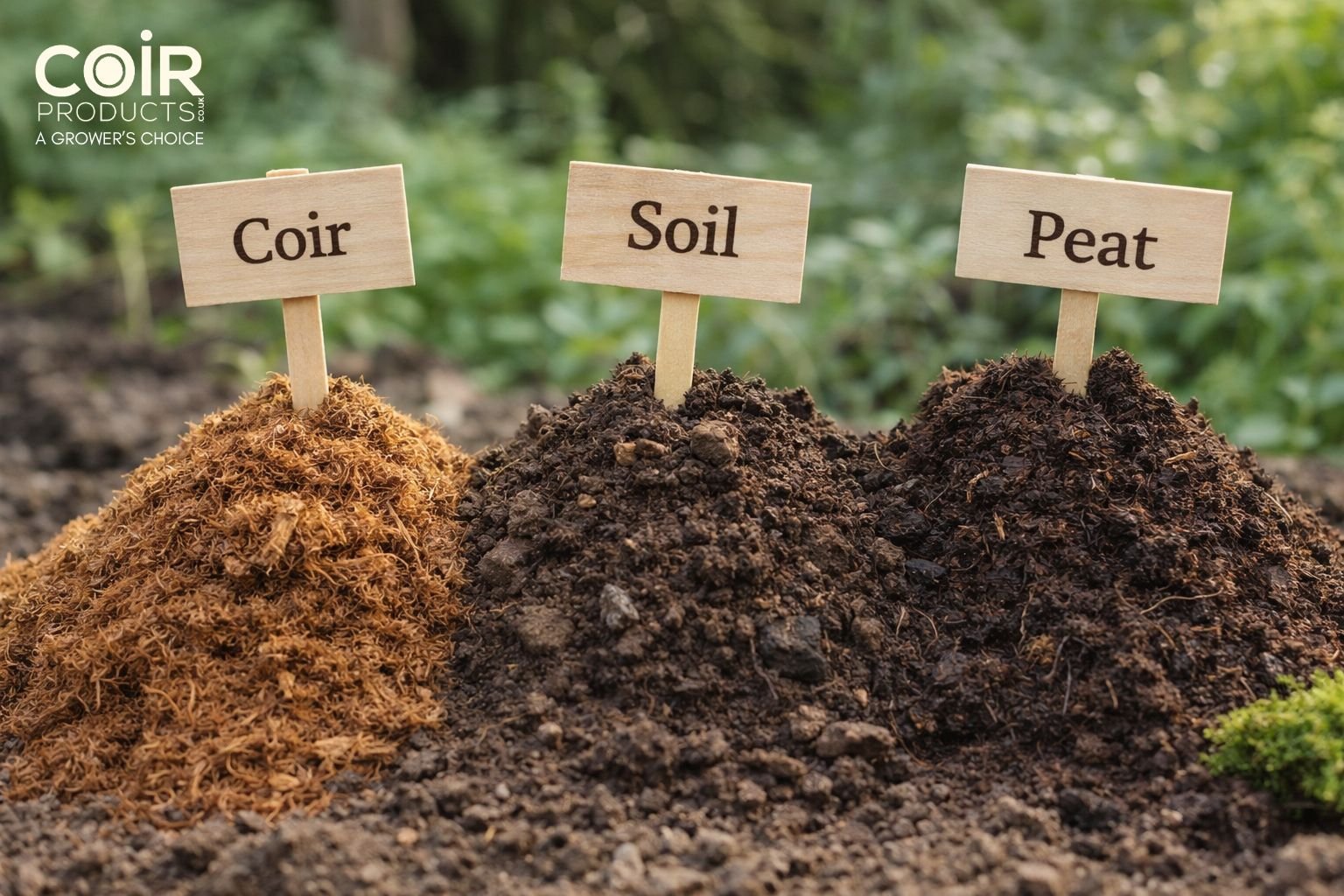
Choosing the right growing medium is one of the most important decisions any grower makes. Yet, it’s often reduced to habit rather than understanding. Soil, peat, and coir each behave very differently and those differences directly impact plant health, root development, and long-term growing success.
At CoirProducts, we believe modern growing demands more than tradition. It requires clarity, consistency, and a deeper understanding of how substrates perform under real conditions.
Water Retention: It’s Not Just About Holding Moisture
Water retention is often misunderstood. It’s not simply about how much water a medium holds it’s about how it holds and releases it.
- Soil can retain water unevenly, often leading to dry pockets and saturated zones
- Peat holds significant moisture but can become hydrophobic when dry
- Coir offers balanced water retention, rehydrating quickly and distributing moisture evenly
This balance allows roots to access water consistently without becoming waterlogged, a critical factor in preventing stress.
Air-Filled Porosity: The Hidden Advantage
Healthy roots need oxygen just as much as water. This is where air-filled porosity becomes essential.
- Soil, especially in containers, tends to compact over time reducing airflow
- Peat has moderate aeration initially but can compress with repeated watering
- Coir potting mix, by structure, maintains air pockets even after prolonged use
This sustained aeration supports root respiration, encouraging stronger and more resilient root systems.
pH Stability and Buffering
The pH of a growing medium influences how effectively plants can absorb nutrients.
- Soil varies widely depending on composition and location
- Peat is naturally acidic and often requires adjustment
- Coir potting mix typically offers a more neutral and stable pH range
This stability simplifies nutrient management, allowing growers greater control over feeding strategies without constant correction.
Nutrient Holding Capacity (CEC Explained Simply)
Cation Exchange Capacity (CEC) refers to a medium’s ability to hold and exchange nutrients.
In simple terms:
- A higher CEC means nutrients are retained and made available to plants over time
- Soil can have high CEC but is inconsistent
- Peat also retains nutrients well but can lock them under certain conditions
- Coir provides a balanced CEC, holding nutrients while allowing efficient uptake
This creates a more predictable growing environment something modern growers increasingly rely on.
Environmental and Sourcing Considerations
Beyond performance, growers today are thinking more carefully about where their materials come from.
- Soil extraction can disturb natural ecosystems when not managed responsibly
- Peat harvesting has long been associated with environmental concerns due to slow regeneration
- Coir potting mix, by contrast, is crafted from a byproduct of the coconut industry repurposing material that would otherwise go to waste
This makes coir a practical choice for those seeking to align performance with responsible sourcing.
A Modern Growing Perspective
There is no single “perfect” growing medium but there is a clear shift towards materials that offer consistency, performance, and control.
Coir stands at the intersection of these needs:
- Structurally stable
- Balanced in water and air management
- Predictable in performance
At CoirProducts, we don’t position coir as a replacement driven by trend but as a progression shaped by better understanding.
Because when growers move beyond tradition and start working with the science of growing media, better results naturally follow.
 Share:


Leave a Reply