
FREE DELIVERY MAINLAND, UK Dismiss
Skip to content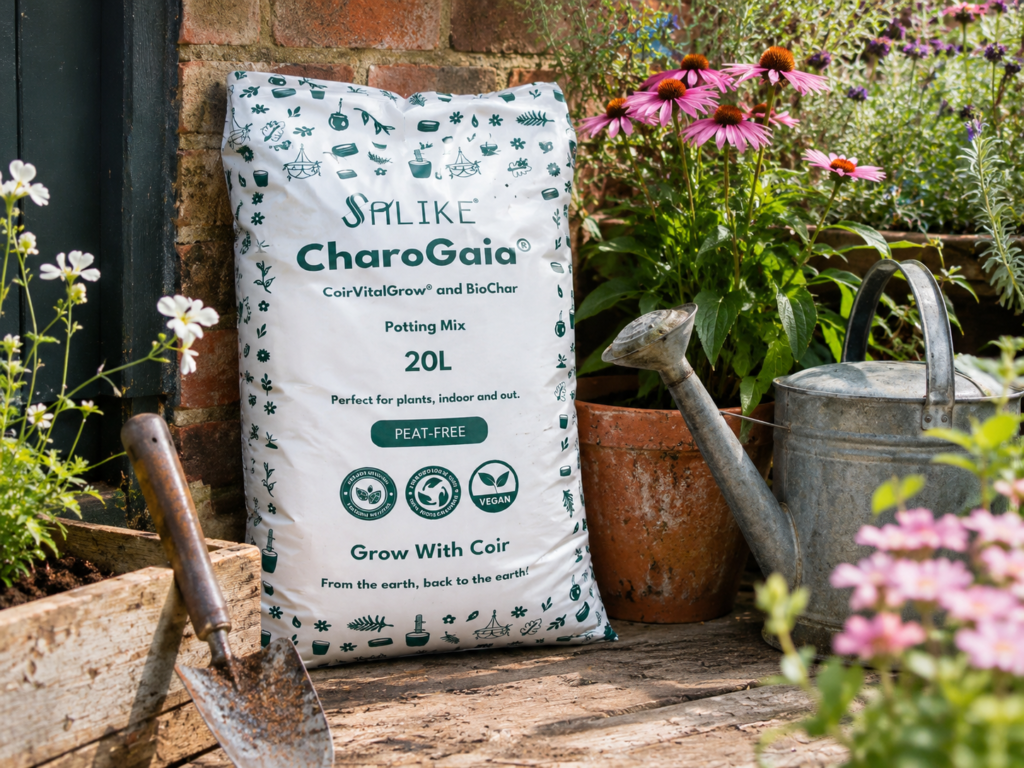
There’s no shortage of compost to choose from these days. Walk into a garden centre or browse online and you’ll find everything from traditional multipurpose compost to specialist mixes for seedlings, houseplants and vegetables.
Then there’s biochar. It’s a material that’s attracting increasing interest in horticulture, but unless you’ve come across it before, you might reasonably wonder what it actually does.
Is it a fertiliser? Does it replace compost? And why would you want it mixed with coir?
At CoirProducts®, we’ve spent more than a decade working with coir and exploring how it can be used in different growing media. CharoGaia® is one of the more interesting additions to our range, bringing coir and biochar together in a ready-to-use 20-litre growing mix.
Here’s what goes into it, why the combination is worth considering and where it might fit into your gardening.
Coir comes from the outer husk of coconuts. Once processed for horticultural use, it becomes a lightweight, fibrous growing medium that can absorb moisture while maintaining air spaces around plant roots.
That balance matters. Roots need access to water, but they also need oxygen. A growing medium that remains constantly saturated can create problems, just as one that dries out too quickly can make watering difficult.
Coir is also used as a peat-free alternative in growing media, either on its own or blended with other materials to achieve different characteristics.
If you’ve used our Coir Vital Grow® potting mix, you’ll already be familiar with the way coir absorbs water and loosens into a workable growing medium.
CharoGaia® takes a slightly different approach by combining coir with another material: biochar.
Biochar is a carbon-rich material produced by heating organic matter in an environment with very little oxygen. The process is called pyrolysis.
The finished material resembles charcoal, although biochar intended for horticultural use is produced for a different purpose from ordinary barbecue charcoal.
What makes it interesting to growers is its porous structure.
Depending on how it’s produced, biochar can have a network of tiny spaces capable of holding water and interacting with nutrients within a growing medium. Certain types may also influence the conditions in which soil microorganisms live.
There is one important distinction, though: biochar isn’t automatically a fertiliser.
Its properties vary considerably according to the original material and production process, and the benefits depend on how it is used.
That’s why the composition of the finished growing mix matters more than simply seeing the word biochar on a bag.
Coir and biochar bring different characteristics to a growing medium.
Coir provides the fibrous structure, moisture retention and air spaces that make it useful for container growing.
Biochar introduces a porous, carbon-rich component that may help the mix retain water and nutrients, depending on its properties and the conditions in which it is used.
The idea is to bring these materials together in a balanced growing mix rather than expect either one to do everything.
Our CharoGaia® 20L Coir & Biochar Compost has been developed around that combination.
For gardeners, the attraction is straightforward: you don’t have to buy separate bags of coir and biochar, work out the proportions or experiment with mixing them yourself.
CharoGaia® is supplied ready to use, making it a convenient way to try a coir-and-biochar growing medium.
One of the advantages of CharoGaia® is that it can be used for several everyday gardening jobs.
Pots and containers
Whether you’re planting flowers for the patio or refreshing a suitable container, CharoGaia® provides a peat-free growing medium that can be used straight from the bag.
As with any container compost, good drainage and appropriate watering are important.
Herbs and vegetables
CharoGaia® can also be used for suitable herbs and vegetable crops.
Bear in mind that different plants have different nutritional requirements. Fast-growing vegetables and fruiting crops may need additional feeding as they develop.
Houseplants
For many everyday houseplants, a coir-based mix can be a useful option.
However, plants with specialist requirements, such as certain orchids, cacti or succulents, may need a different growing medium or additional ingredients to achieve the drainage and structure they prefer.
Raised beds and garden soil
CharoGaia® can be incorporated into existing topsoil when preparing raised beds or planting areas.
Rather than using it as the sole material to fill a large bed, follow the product guidance for mixing it with soil. The condition of the existing ground and the crops you intend to grow will influence how best to prepare the area.
Yes, although the distinction is worth understanding.
A conventional coir growing medium relies primarily on the properties of processed coconut husk material. Depending on the product, it may also contain fertilisers or other ingredients.
CharoGaia® includes biochar as part of its formulation.
That doesn’t automatically mean it’s the best choice for every plant, or that a coir-and-biochar blend will always outperform a conventional compost.
It simply offers a different combination of materials and growing characteristics.
If you prefer a straightforward coir potting mix, Coir Vital Grow® may be more appropriate. If you’re interested in exploring a growing medium that incorporates biochar, CharoGaia® is worth considering.
The choice should come down to what you’re growing and how you prefer to garden.
There’s no complicated preparation involved.
For pots and containers, loosen the compost gently before use, fill your container and position the plant at the appropriate depth.
Settle the growing medium around the roots without compacting it excessively, then water and allow any excess moisture to drain.
After planting, check the moisture regularly rather than watering to a fixed timetable.
A pot on a warm, sunny patio will dry differently from one indoors, and a large established plant will use water differently from a small seedling.
It’s also worth keeping an eye on feeding requirements. Biochar may influence how nutrients are held within a growing medium, but plants still need an adequate nutrient supply.
For herbs, vegetables and other demanding crops, additional fertiliser may be needed as growth progresses. Follow the product guidance and choose a feeding programme suitable for your plants.
CharoGaia® is particularly worth a look if you’re interested in trying something beyond a conventional coir growing medium.
Perhaps you’re growing herbs in containers, planting seasonal flowers or looking for a peat-free compost for everyday gardening.
Or perhaps you’ve been reading about biochar and would like to try a prepared blend without having to source the ingredients separately.
The 20-litre bag is a convenient size for smaller planting projects, especially when you don’t need a large quantity of growing medium.
It’s not a specialist compost for every possible plant, and it doesn’t remove the need for sensible watering and feeding. But for suitable everyday growing applications, it gives gardeners another option.
When choosing compost, it’s easy to concentrate on what we’re planting and give less thought to the material surrounding the roots.
Yet the growing medium plays an important part in how water, air and nutrients are available to the plant.
At CoirProducts®, we’ve specialised in coir-based growing products in the UK since 2015. Over that time, we’ve developed a range of growing media for different gardening needs, from straightforward coir potting mixes to more specialised blends.
CharoGaia® is part of that approach. It brings together the familiar properties of coir with the possibilities offered by biochar, in a ready-to-use compost for suitable indoor and outdoor growing.
If you’re curious about trying the combination for yourself, take a look at our CharoGaia® 20L Coir & Biochar Compost.
Sometimes, choosing the right growing medium begins with understanding a little more about what’s in the bag.
Added to cart
Check out our shop to see what's available